Getting to Quito
August 18, 2004
 American Airlines flight #967 touches down “hot” on Quito’s 9,000’ elevation
runway, I disembark to a spotless and gleaming new international terminal and on
Saturday evening complete a grueling 24-hour trip from Seattle that includes a
ten-hour layover in Miami. The normal drill is a two-hour wait to be cleared
through customs by a surly agent, but I’m in and out in ten minutes with a
smile, collect my bags, am asked the price of my motorcycle helmet, for what
will undoubtedly be the first of many times over the next few months, catch a
taxi, and within 45 minutes of landing check in at the Crossroads Hostel.
Remarkable. I’m asleep almost before the door key clears the lock.
American Airlines flight #967 touches down “hot” on Quito’s 9,000’ elevation
runway, I disembark to a spotless and gleaming new international terminal and on
Saturday evening complete a grueling 24-hour trip from Seattle that includes a
ten-hour layover in Miami. The normal drill is a two-hour wait to be cleared
through customs by a surly agent, but I’m in and out in ten minutes with a
smile, collect my bags, am asked the price of my motorcycle helmet, for what
will undoubtedly be the first of many times over the next few months, catch a
taxi, and within 45 minutes of landing check in at the Crossroads Hostel.
Remarkable. I’m asleep almost before the door key clears the lock.
Fervently I had hoped not to start this trip with a story of either customs or
motorcycle problems, but it is not to be, I’m afraid, although having gone
through this with me in Costa Rica three years ago, I’ll spare you the great
majority of the laborious details, while making a few salient points.
First, although its location is not disclosed to protect the guilty, there’s
obviously a school of bureaucracy and attendance is mandatory by customs agents.
The school teaches three rules, as follows: it will take four times as long as
is necessary, you will be made to feel as insignificant as is humanly possible,
and it will cost twice what you planned on. Ecuador, like Costa Rica before it,
completed this school with flying colors. I’m still puzzled why the young lady
at the passenger terminal wasn’t required to attend.
 Second, unlike in Costa Rica, the Ecuadorian Aduana is staffed with very
attractive women in modestly short blue skirts, gray blouses and two and a
half-inch blue pumps (OK, it’s just an estimate.) Continuously they march back
and forth between offices, documents in hand, their high heels tap, tap tapping
on the wooden floor, and while they don’t appear to accomplish much, at least
based on all the folks still sitting, watching them certainly makes the waiting
more bearable. (By comparison, the Costa Rica office was staffed mostly by men
in scruffy clothes.) As an aside, those “not in uniform” have on three-inch
spike heels, and as it turns out, such footwear is not confined to just the
customs office, but is prevalent throughout Quito. So, here’s my tip. If you’re
young and don’t mind relocating, I’m guessing that there’s big money to be made
in Quito as a podiatrist. Who would know?
Second, unlike in Costa Rica, the Ecuadorian Aduana is staffed with very
attractive women in modestly short blue skirts, gray blouses and two and a
half-inch blue pumps (OK, it’s just an estimate.) Continuously they march back
and forth between offices, documents in hand, their high heels tap, tap tapping
on the wooden floor, and while they don’t appear to accomplish much, at least
based on all the folks still sitting, watching them certainly makes the waiting
more bearable. (By comparison, the Costa Rica office was staffed mostly by men
in scruffy clothes.) As an aside, those “not in uniform” have on three-inch
spike heels, and as it turns out, such footwear is not confined to just the
customs office, but is prevalent throughout Quito. So, here’s my tip. If you’re
young and don’t mind relocating, I’m guessing that there’s big money to be made
in Quito as a podiatrist. Who would know?
Finally, the papers are signed at five minutes prior to the 4pm closing time,
and with some help I have the bike uncrated and reassembled, at least enough to
run, two hours later.
Unfortunately, though, running is a relative term. Again, I’ll spare you the
myriad details of being hopelessly lost in Quito, a city of well over a million,
in the dark, the BMW hitting on just one cylinder while quickly overheating in
the thin mountain air, and luckily spotting a Suzuki bike shop with a mechanic
who helps me diagnose and fix the problem of no fuel reaching the right
cylinder.
 But I’m still lost in Quito, with scant idea of the route to the hostel, and so
in time-honored adventure-travel tradition I cut off a taxi, shout the address
and am quoted a dollar to follow him there. “One US dollar,” I think? Of course,
I’m certain that he has no idea what I said, but I have few options.
But I’m still lost in Quito, with scant idea of the route to the hostel, and so
in time-honored adventure-travel tradition I cut off a taxi, shout the address
and am quoted a dollar to follow him there. “One US dollar,” I think? Of course,
I’m certain that he has no idea what I said, but I have few options.
Less than five minutes later we arrive at the door; the bike and a little of my
self-confidence still intact.
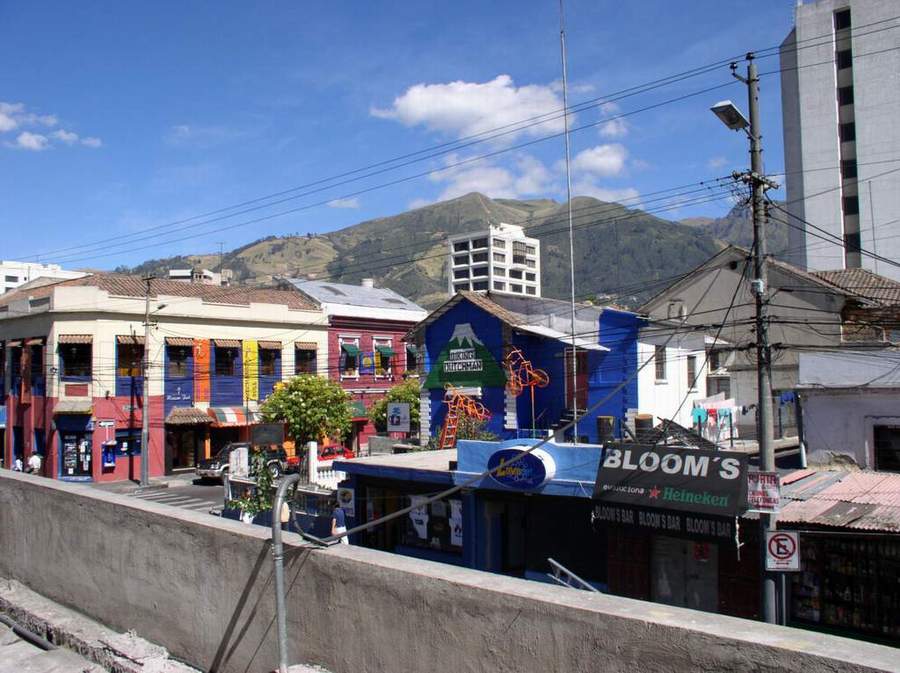
As I’m writing this early on Tuesday morning over a latte at The Magic Bean
Café, in the Mariscal Sucre district of Quito, the sun shines brilliantly from a
clear blue sky, while a soft breeze makes my light jacket a necessity in the
cool morning air. The Andes, easily reaching heights of 12,000’ less than three
miles away, encircle the city and cradle Quito as a bassinet cradles a baby,
while Mt. Cotapaxi, snow-covered at almost 20,000 feet, stands sentinel just a
few short miles south of the city center.
Customs seems a minor inconvenience and a distant memory.
