Cafayate, Argentina
September 17, 2004
Leaving Bolivia, Part II
 Monday I spend writing, taking a two-hour nap to ward off the rigors of the
previous night on Wilma’s living room floor, and meet her driver, Jose, who hops
on the back of my bike as we drive the streets of Uyuni looking for a place
where I can change my oil. I have the filter and tools, and acquiring the oil is
simple, but disposing of the used oil is my main concern.
Monday I spend writing, taking a two-hour nap to ward off the rigors of the
previous night on Wilma’s living room floor, and meet her driver, Jose, who hops
on the back of my bike as we drive the streets of Uyuni looking for a place
where I can change my oil. I have the filter and tools, and acquiring the oil is
simple, but disposing of the used oil is my main concern.
At around 7pm I’m back at Arco Iris for dinner, only to find that there has been
a slight change of plans. A tourist from Caledonia, an island off the coast of
Australia, I’m told, needs an English translator, and Wilma has volunteered. He
is presently at Laguna Colorado, on the Salar, and at least a half-day from
Uyuni.
Tuesday night we will stop in Tupiza, on the way to Villazon, and by various
estimates anywhere from four to eight hours from Uyuni. That has been a problem
from the start. I just can’t get a handle on the actual distance from Uyuni to
Tupiza or on to Villazon. My Bolivia map has no distances indicated for
secondary roads, and using the scale, it could be anywhere from 150 to 250km (90
– 155 miles) to Tupiza, depending on the twists and turns. Wilma, with Jose
driving, will leave about 2pm, after she talks to the Caledonian tourist. At 9am
Tuesday morning I’m on my way.
By the way, while I’m writing this three days later, with spring well advanced,
and at a sidewalk table on the shady side of a sunny street in the small
Argentine town of Cafayate, Eric Clapton belts out “Tears In Heaven” on the
stereo system. If only I could sing. Do you think the government of Argentina is
enforcing Clapton’s copyrights? Let’s see, Microsoft estimates that 98% of its
software in China is pirated. To my entreaty, “hay, helado?” (is there ice
cream,) the waiter assures me that there is Swiss vanilla. For my efforts I’m
treated to a well-melted Eskimo pie. Nah, Clapton’s not getting royalties, and
National Geographic won’t pick this up. I’ll keep my day job.
 The road from Uyuni towards Tupiza is both unmarked and unremarkable. It’s
simply a graded triple-track that heads across the vast desert that surrounds
the town. In fact, I ask twice to ensure that I’m on the correct one of the two
desert tracks that head east from Uyuni. My only saving grace is that in La Paz
I purchased a map with much better detail than my highway map, and it shows the
railway line on the left-hand side of the road, until it crosses the highway
just east of the pueblo of Atocha, about half-way to Tupiza. With a compass and
knowledge of the railroad line, I should be fine, even without signs. The gravel
surface, while very rough from the washboard, is acceptable, particularly
without the heavy bags, and I make good time.
The road from Uyuni towards Tupiza is both unmarked and unremarkable. It’s
simply a graded triple-track that heads across the vast desert that surrounds
the town. In fact, I ask twice to ensure that I’m on the correct one of the two
desert tracks that head east from Uyuni. My only saving grace is that in La Paz
I purchased a map with much better detail than my highway map, and it shows the
railway line on the left-hand side of the road, until it crosses the highway
just east of the pueblo of Atocha, about half-way to Tupiza. With a compass and
knowledge of the railroad line, I should be fine, even without signs. The gravel
surface, while very rough from the washboard, is acceptable, particularly
without the heavy bags, and I make good time.
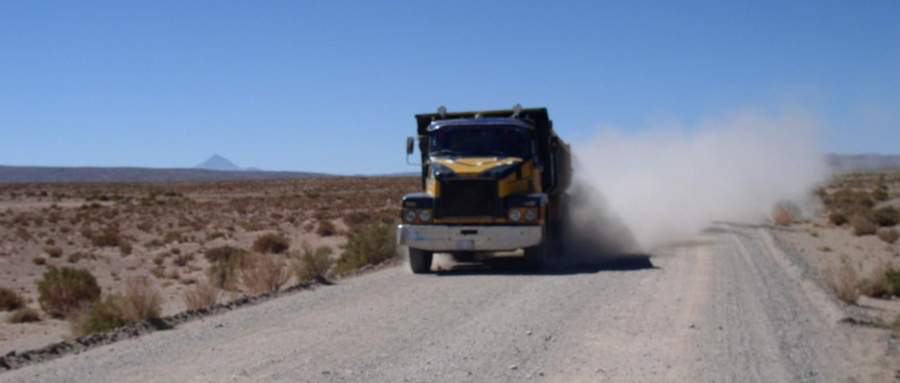
My second real break of the Villazon journey, meeting Wilma was obviously the
first, occurs about thirty minutes out of Uyuni when I stop for an approaching
truck. It is spewing a veritable dust storm in its wake, and I pull over rather
than be engulfed by the following cloud. As I re-bag my camera, a motorcycle
appears in my rear view mirror, and I motion it to stop. Up pulls the first of
two Honda Transalps, which I noticed yesterday in Uyuni, while Jose and I sought
a location for the used oil.
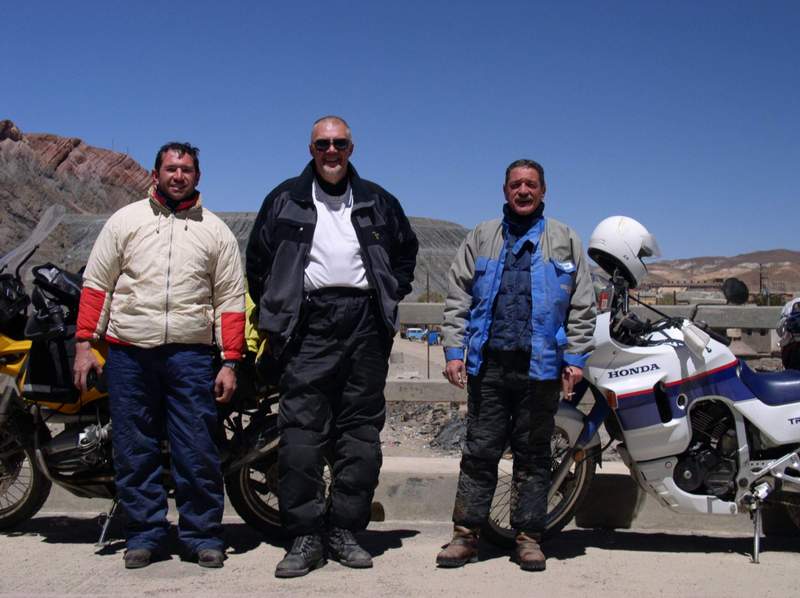
 Jorge, and his buddy Roberto, up from Salta, Argentina just two days ago to
visit the Salar, are now returning. We agree to ride together. I’m happy that I
won’t have to tackle it alone, and with full bags.
Jorge, and his buddy Roberto, up from Salta, Argentina just two days ago to
visit the Salar, are now returning. We agree to ride together. I’m happy that I
won’t have to tackle it alone, and with full bags.
Around sixty kilometers (35 miles) into the trip I look for the road to turn
north and cross the railroad tracks, but that never happens. However, the
numerous sidetracks are clearly inferior to the double tracks we are on, and
since the Argentineans have ridden the road before and press on, I continue as
well.
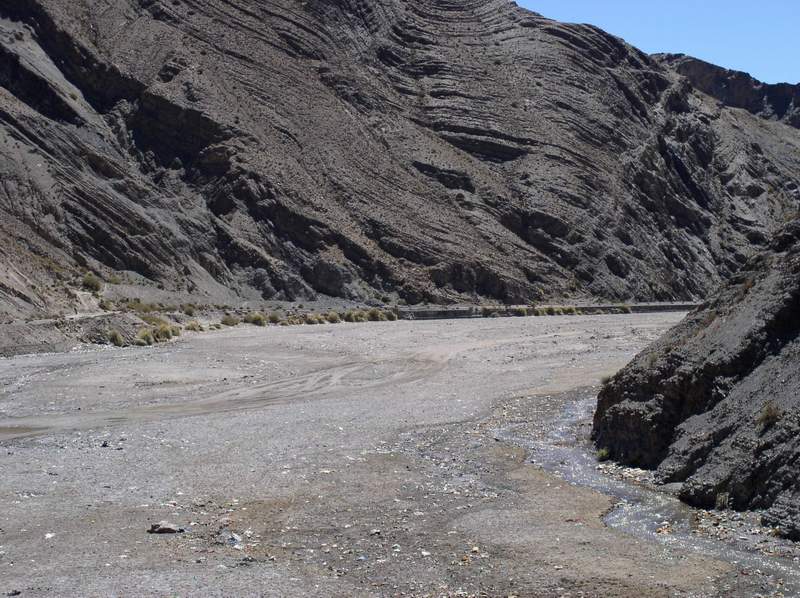
About 100km from Uyuni the road is blocked and following vehicle tracks, we
detour to the riverbed. It’s 500 meters wide (a quarter of a mile,) and
thankfully, less than a foot deep in most places. Rocks and sand, each plentiful
now, make up for the lack of water, and we ride in the riverbed some ten
kilometers (six miles) to the pueblo of Atocha, where we make proper
introductions on a long bridge; the only paved surface for hundreds of miles. As
an aside, I find the modern, paved bridge incongruous in an area where the
highway proper runs through the river. Jorge Brandon, the older of the two
Transalp riders, is an attorney, and Roberto, his sidekick, a contrador publico;
a CPA like me. We share a few words in common, and motorcycling is a fraternity,
so we have little difficulty both maintaining a dialogue and establishing
rapport.
While on the bridge, Jorge says “Butch Cassidy, aqui (here)” and draws a finger
across his throat, indicating that Butch and the Sundance Kid died in Atocha. If
so, they got their just rewards for a life of crime. Atocha may literally be the
end of the earth. But if not in Atocha, then certainly close by. The mining
company whose payroll they robbed was from Tupiza, our destination. I’ve heard
San Vincent, a nearby pueblo as the location of their demise, but we’re
splitting hairs here. We’re in the riverbed for a bit less than another six
kilometers (four miles) when the road reappears.
 Maybe twenty kilometers (twelve miles) past Atocha there is a fork in the road,
and to paraphrase Robert Frost, “their passing is really about the same.” We
stop, not certain which fork to take. However, the only discernable physical
feature out here is a prominent mountain, perhaps ten kilometers (six miles)
away. The left fork appears to head north of the mountain, while the right goes
east. Of course, there are no signs. As we consult our respective maps, it’s
apparent that we need to keep the mountain on our left. When stopped, an
approaching truck confirms our choice, and we head east.
Maybe twenty kilometers (twelve miles) past Atocha there is a fork in the road,
and to paraphrase Robert Frost, “their passing is really about the same.” We
stop, not certain which fork to take. However, the only discernable physical
feature out here is a prominent mountain, perhaps ten kilometers (six miles)
away. The left fork appears to head north of the mountain, while the right goes
east. Of course, there are no signs. As we consult our respective maps, it’s
apparent that we need to keep the mountain on our left. When stopped, an
approaching truck confirms our choice, and we head east.
At about 160km (100 miles) the road to Tupiza begins its 1,000m (3,300’) plunge
off the Altiplano to the valley that contains Tupiza, on a tortuous and
circuitous route with lots of sand on downhill turns. We proceed cautiously, but
move forward. Roughly two hours from Tupiza, Jorge, the lead rider now, pulls
over at a wide spot, and on a small-unrolled tarp, Roberto lays out crackers and
canned ham. Sensing lunch, I add a can of tuna and some cookies. There, by a dry
streambed, on an appalling double-track route through the desert, we break
bread. I’m still smiling now as I think of it.
Of course we make Tupiza, which turns out to be 220km (135 miles) from Uyuni, in
over six hours. After securing the bike and a quick shower, I’m walking from the
hotel to the plaza for dinner, when Wilma and her entourage, now including Jose,
Sabrina, a babysitter and Roberto, the hostal owner, pull up by the curb. They
made the trip in less than four hours in their Toyota Land Cruiser. Relieved to
see me, they are concerned that I took the wrong fork past Atocha. We agree to
meet the next morning for breakfast. Returning from dinner I share dessert with
the two Argentine Transalp riders, who explain that they’re leaving first thing
in the morning. We trade e-mail addresses and bid each other a safe journey.
Over breakfast, Wilma explains that they will leave for Villazon in two hours,
rather than the following morning, as originally planned. If I’d like, they’ll
take my bags and meet me at the border. Of course, I accept. The 100km (sixty
miles) from Tupiza to Villazon is much less demanding, and I make it in two
hours.
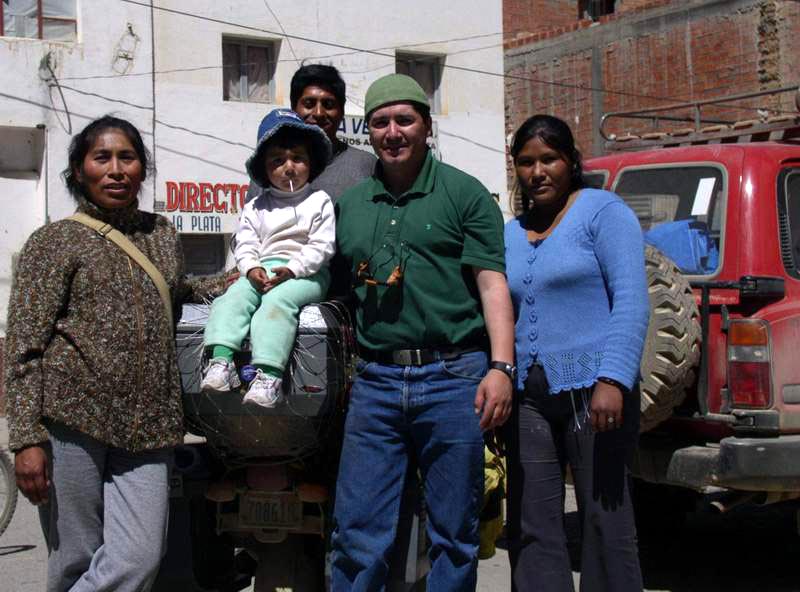 We all have lunch together before crossing into Argentina, and they stand by as
I retrieve my hard bags and repack the bike. With several rounds of photos,
handshakes and hugs, we wish each other a safe journey.
We all have lunch together before crossing into Argentina, and they stand by as
I retrieve my hard bags and repack the bike. With several rounds of photos,
handshakes and hugs, we wish each other a safe journey.
Jose is staying in Bolivia with the Toyota, while Roberto joins Wilma, Sabrina
and the babysitter for the bus ride to Salta. They see me through my exit from
Bolivian customs and immigration, and I lose them in the crush of travelers
crossing into Argentina.
Would I have made it to Villazon without their help? Certainly. Was the journey
made easier and more enjoyable because of their assistance? Absolutely. Do I
have a memory that will last a lifetime because of their involvement? Without a
doubt.
