Cafayate, Argentina
September 17, 2004
Leaving Bolivia
There are three ways to leave Uyuni, Bolivia. I can ride from Uyuni to Villazon,
on the Argentine border, on what I understand is 325km (200 miles) of very bad
road. I can take the train to Villazon, or I can ride back to Potosi, and take
my chances on the main route to Argentina, Bolivia Ruta 1. The last option
involves 673km (417 miles,) 215km (135 miles) of which, back to Potosi, I
already know are very tough. If the road south from Potosi is paved, it would
have to be very recently.
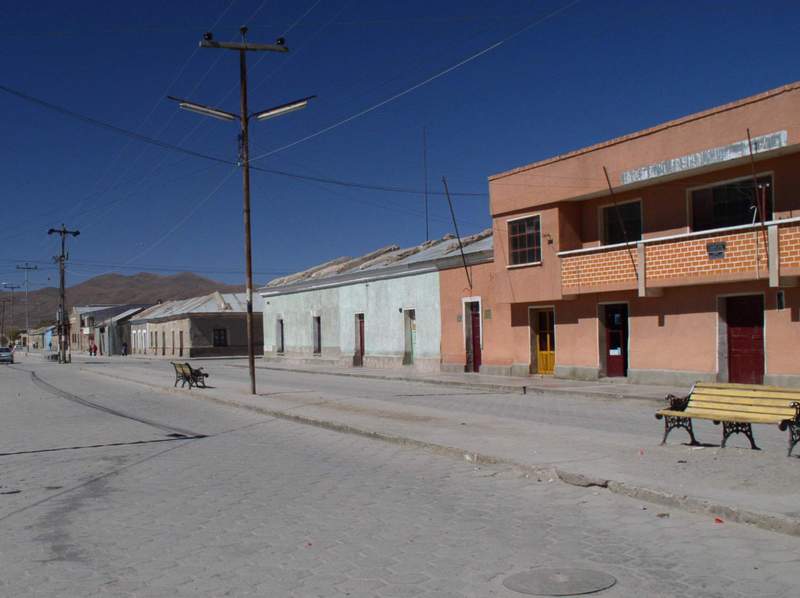 When
I rode to Uyuni I fully intended to ride out to Villazon, with the train as the
second option. Wary of the road out, I’ve received several conflicting options.
When asked, a restaurant owner in Potosi said “no problem.” However, when I ask
Roberto, the Hostal La Magia owner in Uyuni the same question, and much closer
to the situation I might add, he frowns and says “muy mal.” Otherwise, very bad.
I’m further discouraged when I log on to www.ultimatejourney.com, the very
recent (2003) personal account of Chris and Erin Ratay’s four and one-half year
journey around the world on two BMWs. Details of their time in Bolivia include
their trip on this road from Villazon to Uyuni, and show pictures of bikes down
from bad sand, trouble actually determining which tracks are the road, several
water crossings that are quite deep, and some mileage where the road isn’t just
following the river, but is actually in the riverbed. There is safety in numbers
in a situation like that, and there were four of them traveling this route
together. I’ve already determined that I can’t pick the bike up by myself.
When
I rode to Uyuni I fully intended to ride out to Villazon, with the train as the
second option. Wary of the road out, I’ve received several conflicting options.
When asked, a restaurant owner in Potosi said “no problem.” However, when I ask
Roberto, the Hostal La Magia owner in Uyuni the same question, and much closer
to the situation I might add, he frowns and says “muy mal.” Otherwise, very bad.
I’m further discouraged when I log on to www.ultimatejourney.com, the very
recent (2003) personal account of Chris and Erin Ratay’s four and one-half year
journey around the world on two BMWs. Details of their time in Bolivia include
their trip on this road from Villazon to Uyuni, and show pictures of bikes down
from bad sand, trouble actually determining which tracks are the road, several
water crossings that are quite deep, and some mileage where the road isn’t just
following the river, but is actually in the riverbed. There is safety in numbers
in a situation like that, and there were four of them traveling this route
together. I’ve already determined that I can’t pick the bike up by myself.
In addition to the bad road, upon reaching Uyuni I discover that the
rear-mounting bolt on my left Jesse hard bag is not locking properly because the
threads on the bolt are partially stripped. The lock nut appears to have come
loose during the ride from Potosi, and the bag (about forty or fifty pounds
including the contents) has bounced up and down on the threads for a while.
While the nut still turns on the threads, it won’t tighten; so the bag won’t
lock in place. Unlike the top box that is dispensable, the hard bag is critical
to completing my trip, and I’m uncertain that it will take 325km (200 miles) of
pounding without replacement or major mechanical surgery. Replacement is at
least a one or two- week process, as the part must be flown in from the States
and then clear Bolivian customs. DHL could likely get it here in three days.
Clearing Bolivian customs is a whole different matter.
I’m rapidly coming to believe that discretion is the better part of valor, and
that I should take the train.
 Lonely
Planet lists the train schedule as Monday and Friday afternoons, so I decide
that I’ll leave at 5:20pm on Monday for the eight-hour trip to Villazon, on the
Argentine border. But when I arrive at the train station Sunday afternoon to buy
tickets for the bike and me, I find that the schedule has changed. Trains now
leave late on Tuesday and Friday evenings, although there is an additional run
that leaves at 2:30am on Monday. Since I need to get going, I’ll shoot for the
Monday departure; just past midnight on Sunday. However, I don’t find anyone at
the ticket window.
Lonely
Planet lists the train schedule as Monday and Friday afternoons, so I decide
that I’ll leave at 5:20pm on Monday for the eight-hour trip to Villazon, on the
Argentine border. But when I arrive at the train station Sunday afternoon to buy
tickets for the bike and me, I find that the schedule has changed. Trains now
leave late on Tuesday and Friday evenings, although there is an additional run
that leaves at 2:30am on Monday. Since I need to get going, I’ll shoot for the
Monday departure; just past midnight on Sunday. However, I don’t find anyone at
the ticket window.
Back at the Hostal La Magia the receptionist speaks a little English and he
calls the station on my behalf. “Can’t do it tonight is the reply – not enough
men working to load the bike.” Thinking that I might be able to pay the wages of
another worker, I ask for a second call. Roberto, the hostal owner, grasps the
situation and intercedes. He calls Wilma Ignacio, apparently one of the few
towns’ people who speaks English well. I’m handed the phone, and Wilma explains
that she will walk across the street to the station with me if I show up at her
restaurant. When she says Arco Iris, I recognize it as the pizza place where
I’ve had some great cream of asparagus soup each of the prior two evenings. When
I advise her of that, she says, “oh, I remember you. You’re the American, and
you’re tall and fat.” Well, then. About that weight loss these past three years!
An hour later, as agreed, we walk to the station, where she finds the
stationmaster. Wilma is Bolivian, of average height and build, plain looking and
about forty, but with charm and an easy grace that belies her relative youth.
“It is possible,” the stationmaster says, “but the train comes from Ururo, and I
don’t know if there will be room or not.” “How big is it?” he asks. “Three
hundred kilos (approximately 650 pounds,)” I reply. His eyebrows arch in both
amazement and concern. This is obviously not a bike that he has shipped before.
Wilma and I return to the restaurant with some assurance that he will do his
best.
 "You
need to bring the moto here,” Wilma says. “It’s closer to the train station, and
you can park it at my house. The restaurant is open until 11 or 12pm,” she
continues, “and you can stay inside until you need to go to the station at 1am.”
I’m a captive audience since I clearly need her translating skills if I’m to
make that train.
"You
need to bring the moto here,” Wilma says. “It’s closer to the train station, and
you can park it at my house. The restaurant is open until 11 or 12pm,” she
continues, “and you can stay inside until you need to go to the station at 1am.”
I’m a captive audience since I clearly need her translating skills if I’m to
make that train.
Back at the hostal I pack the bike and in a tricky maneuver that requires some
assistance, back it out of the lobby up and over two steps. I return to Arco
Iris at 10pm.
Save for a dozen customers, tourists all, speaking a handful of different
languages, and Wilma and her three employees, the restaurant has wound down for
the evening. Arco Iris, as I’ve previously described, is essentially a pizza
joint with some great cream soups and spaghetti dishes, in addition to pizza,
their main fare. The bar dispenses beer and wine. I’m seated at a corner table
drinking a café con leche (a coffee and milk combination I described in an
earlier journal) and trying to figure out how I’ll remain awake until 1am.
At about 10:30pm a man shows up whom Wilma introduces as Novarto. He’s short,
maybe late-40s, has mixed Indigina and European features, with a quick smile and
an easy laugh. I assume that he’s Wilma’s husband, but as the evening
progresses, it turns out that he’s a friend from Cochabamba, a Bolivian city
some 650km (400 miles) away by road.
As the customers finally wander back to their respective hotels, and the help is
cleaning up, Wilma comes to me and says, “I have called the train station again,
and instead to going there at 1am, we need to call them at 1:30am to see if they
have room for the bike. So, please, you will sleep on the couch at my house
until then.” Going back to the hotel for two hours is out of the question; so
sitting on her couch is better than the alternative – sitting outside in the
bitter cold.
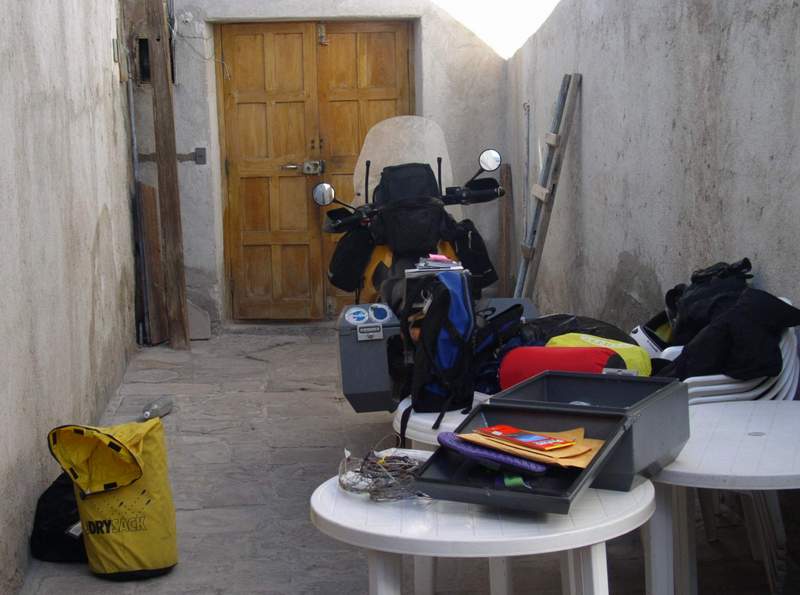
Next to the storefront of the Arco Iris are double doors with a walkway about
eight feet wide that lead to a courtyard. There appears to be several residences
off the courtyard. My bike is parked in the walkway, off the street. Turn right
through another set of doors, and you enter a second courtyard that is Wilma’s
residence, directly behind the restaurant and the adjoining tour company (Trans
Andino Tours,) which she also owns.
A green-painted door leads to a living room, furnished with two sofas and
bookcases, as well as a small table and chair. On the table are a computer and
its peripherals. The room is not large, perhaps the size of an American master
bedroom, but it easily accommodates four adults. Wilma explains that Edwin, her
nephew whom she raises because his father is dead, will get up at 1:30am to call
the station if I will wake him. I set the alarm on my watch. Edwin, a thin and
pleasant adolescent of about fourteen, speaks no English, but Wilma writes down
two sentences: what he will say if there is space, and what he will say if there
isn’t.
Strangely enough, I’m fairly comfortable with the situation and hope to grab two
hours of sleep on the couch before the phone call. Naverto, though, realizing
that the sofa is way too small for my six-foot four-inch frame, appears from the
bedroom with a rollup mattress and a half-dozen blankets. It’s to be my bed on
the living room floor.
At least three bedrooms adjoin the living room, each with glass from the middle
of the wall to the ceiling. The main bedroom, the largest of the group, has a
double bed for Wilma and her two-year old daughter, Sabrina, as well as a single
bed for Edwin. A second bedroom is occupied by one of the restaurant workers,
and the third by her sister who has just arrived in Uyuni from an outlying
pueblo – staggering drunk, I might add. When I inquire where Novato will sleep,
he indicates that he's off to his own house. For most North Americans, used to
lots of personal space, this would be very uncomfortable, but everyone at
Wilma’s seems at ease with the arrangements.
This is the tail end of the South American winter, with seasons reversed from
ours, and it’s very cold at night on the Altiplano this time of year (0 – 20
degrees F.) There’s no heat in any of the buildings, hotels and houses included,
so I’m chilly even with several woolen blankets. Fitfully, I sleep for two hours
before waking Edwin for his call. “Call back at 2am,” is the reply. “We’ll know
then if there’s space.” Of course, at 2am it’s fifteen more minutes, until
finally the call at 2:30am yields this reply. “There is no space tonight. Maybe
Wednesday or Friday, but without guarantee.” I had run into “it’s possible” in
Bolivia before, so I wasn’t all that surprised. My spirits sinking a bit, I add
another blanket and try for a night’s sleep.
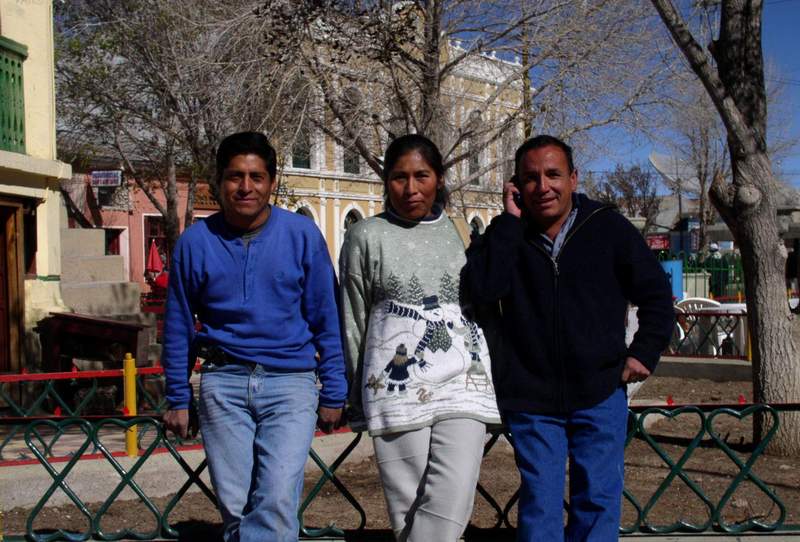 Noverto
shows up for breakfast, and along with Wilma, Edwin and the restaurant worker
(the drunk sister is apparently still incapacitated,) we discuss a plan to get
me to Villazon. Wilma, it turns out, has been married to an Italian banker for
the past fifteen years. For six months a year she lives in Bologna, just south
of the Alps, with her husband and twelve-year old son. Yearly, for two months,
he joins her in Bolivia. Sabrina, born in Italy and without Bolivian
citizenship, is two days overdue on the ninety days she is allowed to remain in
Bolivia. Wilma needs to travel to Salta, Argentina, to get her passport
re-stamped. The road to Salta goes through Tupiza and Villazon, and they will
take my hard bags if I can ride the bike.
Noverto
shows up for breakfast, and along with Wilma, Edwin and the restaurant worker
(the drunk sister is apparently still incapacitated,) we discuss a plan to get
me to Villazon. Wilma, it turns out, has been married to an Italian banker for
the past fifteen years. For six months a year she lives in Bologna, just south
of the Alps, with her husband and twelve-year old son. Yearly, for two months,
he joins her in Bolivia. Sabrina, born in Italy and without Bolivian
citizenship, is two days overdue on the ninety days she is allowed to remain in
Bolivia. Wilma needs to travel to Salta, Argentina, to get her passport
re-stamped. The road to Salta goes through Tupiza and Villazon, and they will
take my hard bags if I can ride the bike.
Now without the bags, I have little concern for the road. Shed of the forty-five
kilos (100 pounds) of the bags and their contents, the Beemer is a whole new
bike, and I readily agree. Without space availability guarantees, it’s obvious
that the train is not a viable option given my time constraints.
Humbled by her concern for a traveler, who after all, is nothing more than a
restaurant customer, and extremely appreciative of my good fortune, I check back
into La Magia for one last night, but leave my bike at Wilma’s. We’ll leave for
the town of Tupiza, most of the way to Villazon, first thing on Tuesday morning.
