Uyuni, Bolivia
September 13, 2004
Uyuni and the Salar de Uyuni
The road to Uyuni
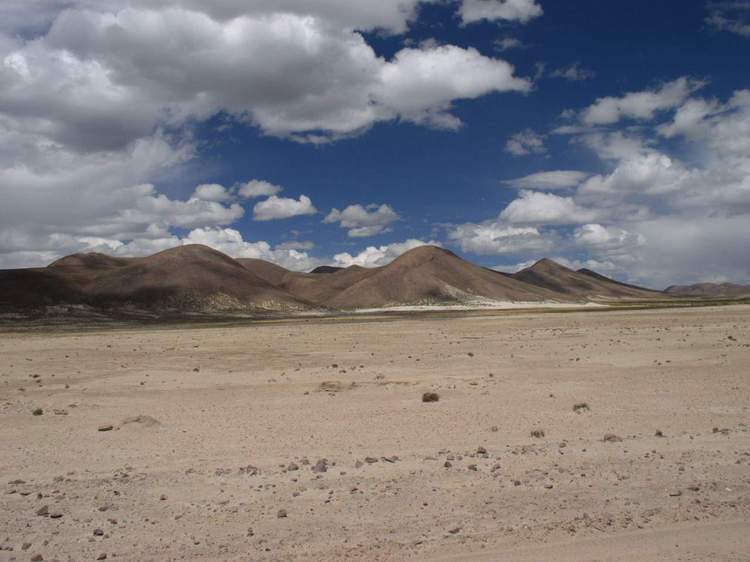
I’m well aware that the 130 miles to Uyuni is gravel, so I’m not surprised when
I pay my five boliviano toll at the police checkpoint leaving Potosi, and head
out on a rough dirt and gravel road. Western Bolivia is arid mountains and high
desert, so the topography through which I’m about to travel won’t be a surprise
either.
What is a surprise, though, is starting at about twenty miles into the ride, the
amount of sand on this road. Now I’m not talking about sand dunes here, although
they do appear on the desert floor from time to time, but the many places where
a few inches of sand cover the roadway.
Here’s the deal with riding in sand on a motorcycle…….I hate it. Maybe I hate it
because I’m not good at it. Maybe I’m not good at it because I’m sure that
motorcycles are meant not to be ridden in it; notwithstanding the fact that they
annually complete the Paris-Dakar race, much of it ridden across the Sahara
Desert.
 Anyway,
sand, particularly deep sand, drags at your front wheel until you eventually
lose your ability to steer and the bike finally falls on its side as the speed
decreases. So riding in it successfully is counter-intuitive. You must stand on
the pegs to lower the center of gravity, squeeze the gas tank with your knees,
use a fair amount of body English, gear down to keep the engine RPMs up, and
give the bike lots of throttle. That keeps the front wheel in a straight line,
and so keeps the bike from falling over.
Anyway,
sand, particularly deep sand, drags at your front wheel until you eventually
lose your ability to steer and the bike finally falls on its side as the speed
decreases. So riding in it successfully is counter-intuitive. You must stand on
the pegs to lower the center of gravity, squeeze the gas tank with your knees,
use a fair amount of body English, gear down to keep the engine RPMs up, and
give the bike lots of throttle. That keeps the front wheel in a straight line,
and so keeps the bike from falling over.
Now I know all this intellectually, but unfortunately, every instinct in your
body tells you to sit down and slow down so it won’t hurt so badly when you
inevitably drop the bike on the ground.
Luckily much of this sand is in short hops, twenty to a few hundred feet at a
time with gravel or dirt at each end. Particularly with a fully loaded bike this
size I’m very tentative, but gradually gather the nerve to stand up and power
through it at 20 – 30mph. The front wheel wobbles a hundred times, and it takes
all my resolve to increase the speed. The sand continues off and on for the
better part of one hundred miles.
 Bolivia
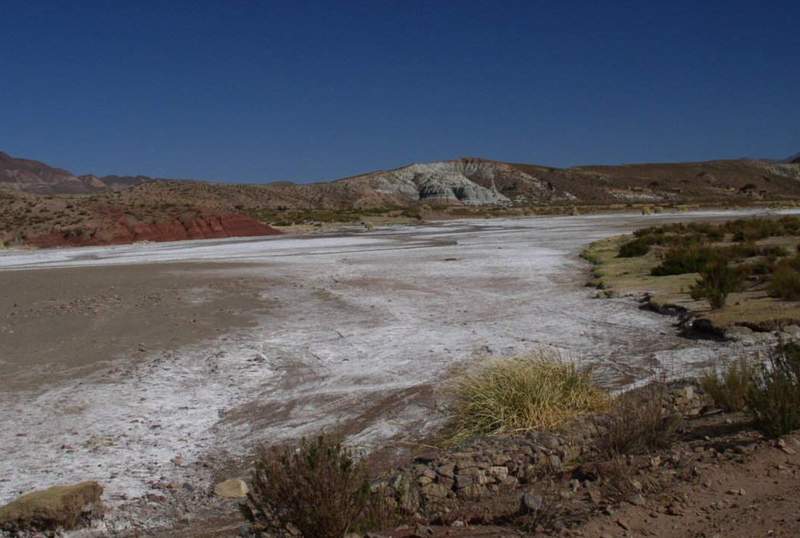
Ruta 701 has splendid scenery. This area contains many mineral deposits (and so
a lot of mining as well, although it’s not visible from the road,) and the brown
hills and desert floor have been turned everything from chocolate brown, to red,
green, and white from their presence. An occasional oasis dots the landscape and
brings with it poplar and willow trees as green as an Irish spring; the color
even more noticeable against the brown background.
Bolivia
Ruta 701 has splendid scenery. This area contains many mineral deposits (and so
a lot of mining as well, although it’s not visible from the road,) and the brown
hills and desert floor have been turned everything from chocolate brown, to red,
green, and white from their presence. An occasional oasis dots the landscape and
brings with it poplar and willow trees as green as an Irish spring; the color
even more noticeable against the brown background.
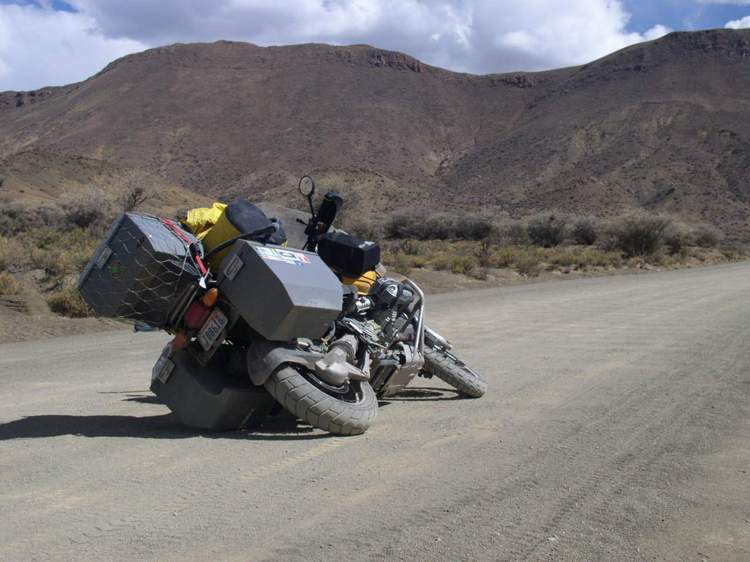
About halfway I stop to remove the rain jacket I added an hour earlier after a
few minutes of sprinkles from some ominous clouds. Not wanting to dismount, I
turn to my right to tuck the jacket under a bungee cord behind me, and feel the
bike lean to the left. I haven’t engaged the kickstand, and as the heavy twin
leans further left, my foot slips and down it goes. I step off, the Beemer
prone.
Now there’s no damage to the bike, although the same can’t be said of my ego,
but try as I might I can’t right it. I give it three shots with proper form
(rear against the seat, lifting with both legs) but it won’t budge; not even a
little bit. A handful of trucks and buses have passed by during the previous
three hours, so I decide to wait for a few minutes rather than unload. At any
rate, the full weight of the bike is on the left hard bag, and it’s full of
tools, so that weight won’t be removed anyway.
 Fifteen
minutes elapses without a vehicle in sight, then as I look back down the road,
over a slight rise walks a peasant driving four donkeys. As he approaches it’s
obvious that he is Juan Hidalgo (Folgers) without the casting session or
pre-photo shoot makeup. Honest, who could make this up? Even with the two of us
lifting, I still need to unload about fifty pounds to right the bike.
Fifteen
minutes elapses without a vehicle in sight, then as I look back down the road,
over a slight rise walks a peasant driving four donkeys. As he approaches it’s
obvious that he is Juan Hidalgo (Folgers) without the casting session or
pre-photo shoot makeup. Honest, who could make this up? Even with the two of us
lifting, I still need to unload about fifty pounds to right the bike.
We literally don’t share a word of vocabulary between us, as it’s quickly
obvious that he doesn’t speak Spanish. (Note: particularly in the rural areas,
many of the indigenous people don’t speak Spanish. Rather, they speak either
Quechua or Aymara.) So as a token of my appreciation I motion to ask if needs
some of my extra water. He declines but indicates that he’s hungry. We split a
roll of cookies and he’s on his way. I don’t believe he even understands my
thanks of “muchas gracias.”
By just after 5pm I arrive at Uyuni, taking six hours to complete the 130 miles.
The tail rack excepted, the bike and I are in one piece.
Uyuni and the Salar
 Almost
thirty years ago when I was engaged in public accounting, we had a few jobs in
the rural areas of Alaska; an area collectively known as “the Bush.” These were
places with names like Dutch Harbor, Kodiak and King Salmon. The common theme is
that they were very small, often Alaska Native villages, and were at the back of
beyond. As accountants we had a saying about those places, and it went like
this: “this is not the end of the earth, but you can see it from here.” Well
that aptly describes Uyuni, Bolivia.
Almost
thirty years ago when I was engaged in public accounting, we had a few jobs in
the rural areas of Alaska; an area collectively known as “the Bush.” These were
places with names like Dutch Harbor, Kodiak and King Salmon. The common theme is
that they were very small, often Alaska Native villages, and were at the back of
beyond. As accountants we had a saying about those places, and it went like
this: “this is not the end of the earth, but you can see it from here.” Well
that aptly describes Uyuni, Bolivia.
We often say that a town has a “frontier feel.” Well Uyuni has the feel, but it
is literally a frontier town as well; not that far north of the Bolivian borders
with Argentina and Chile, and on the edge of the Salar de Uyuni, a vast salt
plain. Although there are high hills is the distance, Uyuni is as flat as a
proverbial pancake. Not one square foot of the town is higher than another. As
it sits right in the desert, dust is everywhere. Walk for a few minutes and it’s
in your clothes and your hair. There’s a hard scrabble feeling to Uyuni; the
feeling you get when everyone is surviving right at the edge of human endurance.
I believe that’s true here, and on the Altiplano in general.
A few blocks of downtown are paved, but they give way to potholes and dirt well
before the town runs out. The buildings, most of adobe, or brick covered with
stucco, are rarely painted. Quite frankly, the little paint there is just
doesn’t quite fit it. There are way too many dogs on the loose, seeming to
collectively belong to the village, rather than to any one individual. Virtually
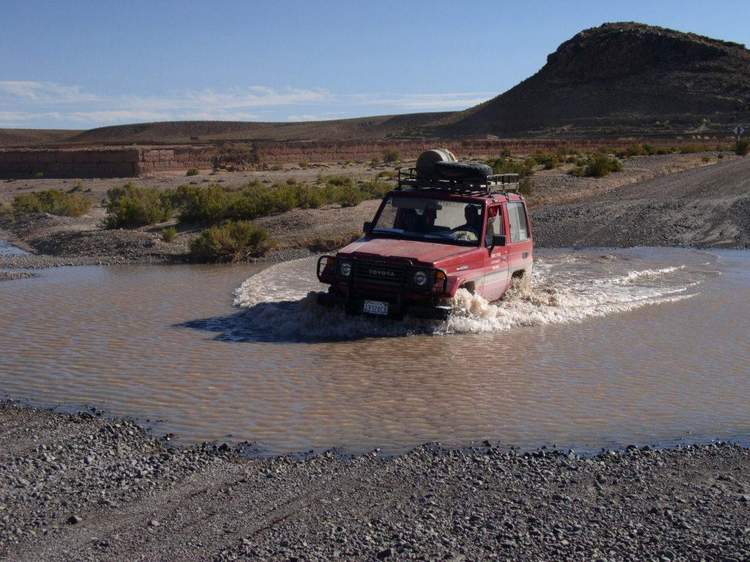
every vehicle is 4-wheel drive. What else could survive the harsh roads? The
airport has neither a terminal building nor a paved runway. It is also
incredibly cold because of the high altitude, and most public places aren’t
heated. I have a plug-in heater in my room, but I opt for my sleeping bag every
night.
 But
in spite of it all, there are lots of tourists in Uyuni because of the Salar. In
fact, that’s why I’m here. Without going into all the details, and thus
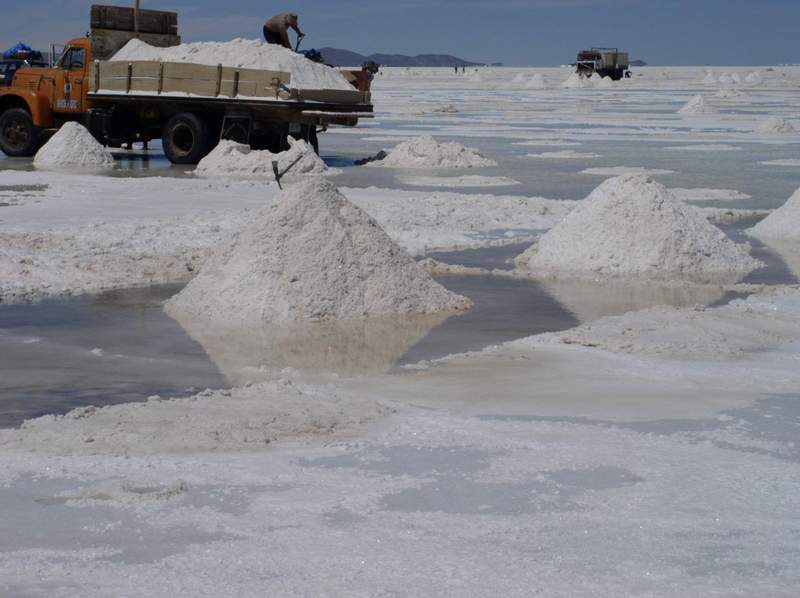
plagiarizing Lonely Planet, the Salar de Uyuni is a dry lakebed at something
around 120km (seventy-five miles) in diameter, at an elevation of 3,650m
(12,000’,) and filled with salt to a depth of six to eight meters (eighteen to
twenty-four feet.) There is a ton of salt here – in fact, ten billion tons is
the official estimate.
But
in spite of it all, there are lots of tourists in Uyuni because of the Salar. In
fact, that’s why I’m here. Without going into all the details, and thus
plagiarizing Lonely Planet, the Salar de Uyuni is a dry lakebed at something
around 120km (seventy-five miles) in diameter, at an elevation of 3,650m
(12,000’,) and filled with salt to a depth of six to eight meters (eighteen to
twenty-four feet.) There is a ton of salt here – in fact, ten billion tons is
the official estimate.
I decide not to get lost on the Salar on my bike, although many try and a few
succeed, as no roads are marked. While I carry a compass, I’ve previously
mentioned that I don’t carry a GPS, and unless you have local knowledge of the
surrounding peaks and islands (as I mentioned, this is an old lakebed, and there
are many islands,) it’s simply impossible to find your way. I opt for a one-day
tour, which misses some of the more spectacular areas of lake colors the result
of mineral deposits, visited in the four-day tours, but strangely there is no
middle ground.
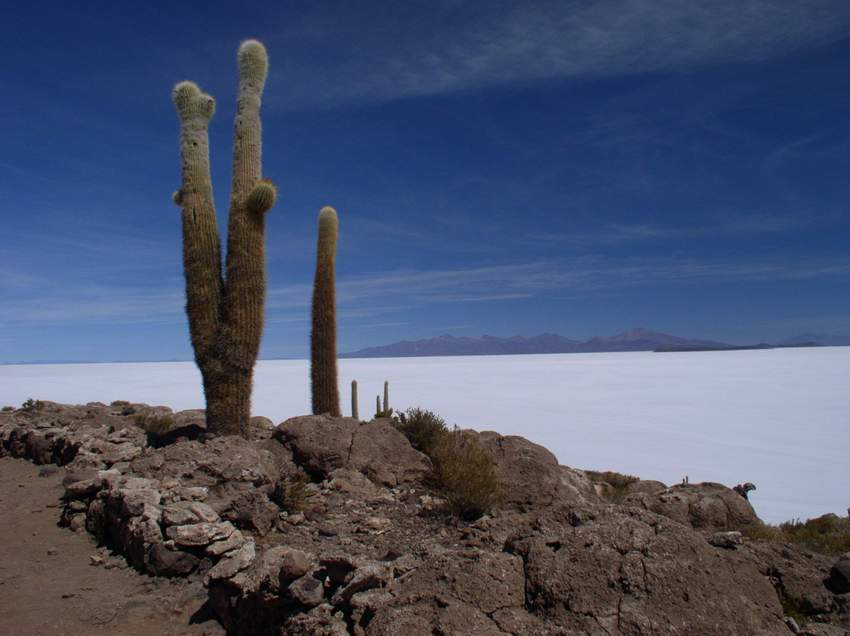
The salt is pure white, and the contrast with the brilliant blue sky is
phenomenal. It is also blinding. Dark glasses are mandatory to eliminate
snow-blindness; as is sun block to prevent severe burning. Among other stops we
visit Inca House Island, some fifty kilometers (30 miles) from Uyuni, and climb
the 350m (1,000’) peak. The climb is some work at this altitude. But at the top,
the view of the Salar alternately looks like snow, clouds or sand as well as
salt, and it continues virtually as far as the eye can see.
After two days rest, on to Argentina.
