La Paz, Bolivia
September 8, 2004
Crossing into Bolivia
Peru has been great to me, both the splendid scenery and the friendly and
accommodating Peruvian people, but it’s time to move on. My flight out of Buenos
Aires is scheduled for September 17, but it’s clear that I won’t make that date,
and Jan has graciously suggested that I extend my departure by a week. I will
take her up on that.
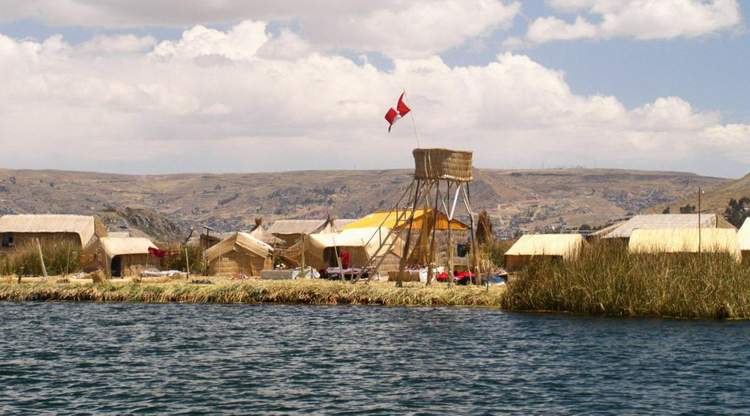 While
I’m anxious to get on to Bolivia, Lake Titicaca, near Puno, is home to one of
only two or three groups of people in the world who live on islands made of reed
mats. (One other is in the Euphrates delta in Iraq, at least before Saddam cut
off their water supply. The allies may have since restored it.) The islands are
about a forty-five minute boat ride from Puno, and I decide that I just can’t
pass them up, so hop an excursion boat for the trip.
While
I’m anxious to get on to Bolivia, Lake Titicaca, near Puno, is home to one of
only two or three groups of people in the world who live on islands made of reed
mats. (One other is in the Euphrates delta in Iraq, at least before Saddam cut
off their water supply. The allies may have since restored it.) The islands are
about a forty-five minute boat ride from Puno, and I decide that I just can’t
pass them up, so hop an excursion boat for the trip.
Although there is another group of islands further from Puno, that I understand
is not as commercialized as the Isla Totora group, it is still very interesting.
This group appears to be comprised of a half dozen islands, the largest of which
is maybe two hundred feet across, made entirely of reed bundles. From walking on
them, and visual inspection, I’d guess that the reeds are four to six feet deep.
The islands themselves are floating, but the lake is shallow here, and I suspect
that live reeds are woven in to keep the islands stationary.
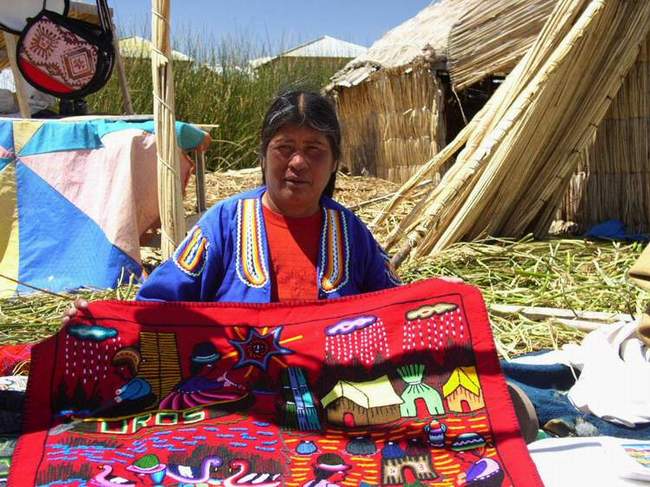 Economically,
the islanders are primarily involved in fishing, and now selling trinkets to
tourists like me. Each island appears to support a half dozen families; their
primitive houses, essentially woven reed bundles. It’s a unique situation and
I’m glad I took the time to see it. After all, it’s not every day that you’re in
Puno, Peru. From Puno it’s eighty-five miles to the Bolivian border at
Copacabana, and I cover it in just over two hours, even taking time for
pictures.
Economically,
the islanders are primarily involved in fishing, and now selling trinkets to
tourists like me. Each island appears to support a half dozen families; their
primitive houses, essentially woven reed bundles. It’s a unique situation and
I’m glad I took the time to see it. After all, it’s not every day that you’re in
Puno, Peru. From Puno it’s eighty-five miles to the Bolivian border at
Copacabana, and I cover it in just over two hours, even taking time for
pictures.
For several months before the start of this trip, every time I saw news of South
America, I marked it on my map, so I would have some idea of current events. By
the village of Llave, Peru I have marked on the map: “Seattle Times – 5/26/04 –
mob kills mayor in dispute over services.” There’s no other road available, so I
pass by quickly. It doesn’t sound like a friendly town.
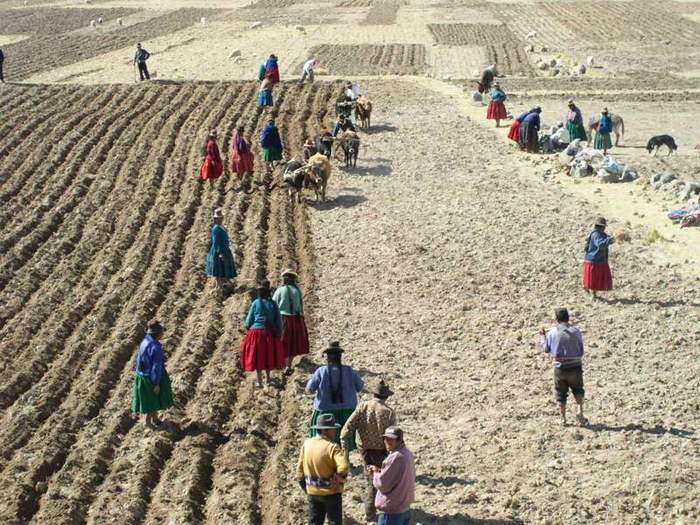 This
is a rural area, with a few small villages, and while there is a fishing
industry in nearby Lake Titicaca, primarily I see Indiginas in full native dress
farming the land in the most primitive fashion, or herding small flocks of
sheep. In other parts of Peru I’ve seen modern farm equipment working large
tracts of land, but not here. From time to time I stop to watch and take some
pictures, but from their looks and gestures, my presence is clearly not
appreciated. I move on.
This
is a rural area, with a few small villages, and while there is a fishing
industry in nearby Lake Titicaca, primarily I see Indiginas in full native dress
farming the land in the most primitive fashion, or herding small flocks of
sheep. In other parts of Peru I’ve seen modern farm equipment working large
tracts of land, but not here. From time to time I stop to watch and take some
pictures, but from their looks and gestures, my presence is clearly not
appreciated. I move on.
National borders are almost always a problem, and I approach them with caution.
In Central America you can usually count on several hours and $30 - $100 in fees
and bribes. So I was surprised when I sailed through the exit from Ecuador and
entry into Peru in an hour, but still I’m wary. Normally I try to cross a border
in the morning, so there’s lots of daylight left in case I run into problems.
But I show up at the Copacabana crossing into Bolivia at 4pm with the time
change, and only three hours of daylight left. It’s the usual gaggle of roadside
vendors, locals crossing back and forth for commercial purposes, and some
tourists trying to move forward. Because of the bike, I have to clear aduanas
(customs – for a transit permit for the bike) both in and out, as well as
immigration (to get my passport stamped,) and often stop by the national police
as well (just because, I believe.) Frequently the buildings are poorly marked,
or unmarked (the case in the Costa Rica/Panama crossing on the Panamericana) and
so it’s a bit of a guessing game as to where to go first.
 But
I’m lucky this time, and as I park my bike a Peruvian Aduanas officer addresses
me in English, and both points out the three stations, then gives me the order
in which to visit them. I’m checked out of Peru in fifteen or twenty minutes. I
ride the bike forward into Bolivia, with similar results, although only customs
and immigration are interested in me. Amazing. I’m out of Peru and into Bolivia
in less than forty-five minutes; a new record for me, I believe. With over two
hours of sunlight left, I ride on to Copacabana and find a hotel.
But
I’m lucky this time, and as I park my bike a Peruvian Aduanas officer addresses
me in English, and both points out the three stations, then gives me the order
in which to visit them. I’m checked out of Peru in fifteen or twenty minutes. I
ride the bike forward into Bolivia, with similar results, although only customs
and immigration are interested in me. Amazing. I’m out of Peru and into Bolivia
in less than forty-five minutes; a new record for me, I believe. With over two
hours of sunlight left, I ride on to Copacabana and find a hotel.
So here’s the scoop on Copacabana, Bolivia. First off, the real Copacabana in
Rio was actually named after this little slice of sand on Lake Titicaca. Second,
it may be the cheapest place for a tourist in the entire world. My hotel room,
without negotiating (bath and shower included,) is less than $5, and it’s pretty
nice. Hot water even. I’m so taken aback by the price that I ask three times,
then make the desk clerk write it down.
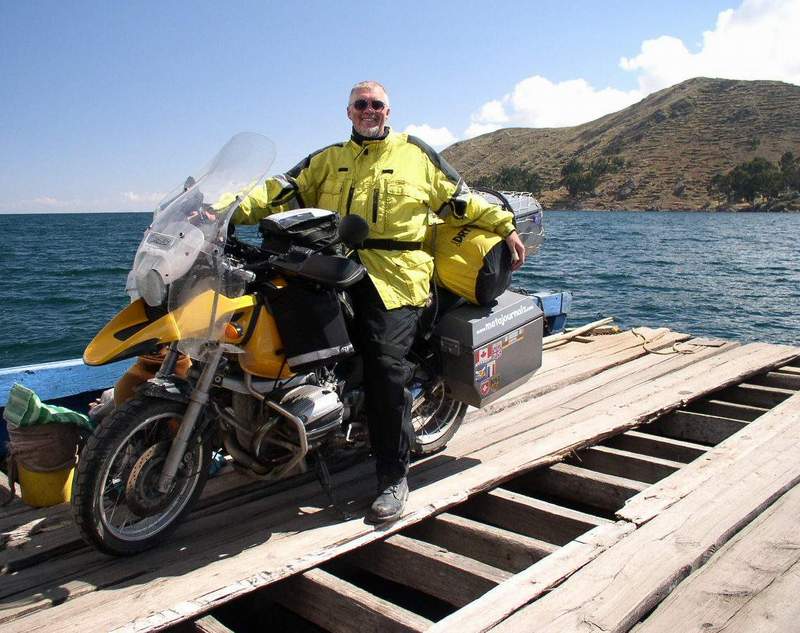 A
Swiss couple (by the way, where are all the Americans down here?) recommend a
local restaurant, and for less than USD $2.25 I have a four-course meal of
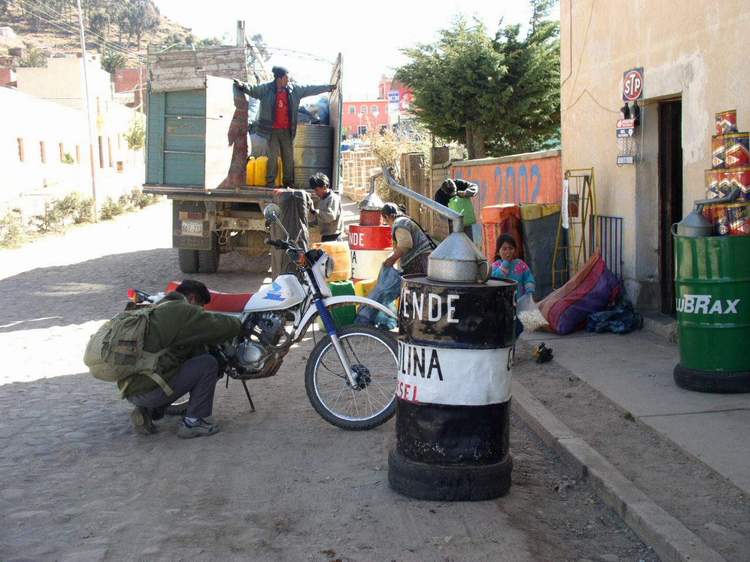
salad, soup, grilled trout and a desert. Now the drawback. In the morning I ask
for the gas station and am directed to a shop across from the hotel that is
dispensing fuel from fifty-five gallon drums. I have enough gas to make La Paz,
so I pass.
A
Swiss couple (by the way, where are all the Americans down here?) recommend a
local restaurant, and for less than USD $2.25 I have a four-course meal of
salad, soup, grilled trout and a desert. Now the drawback. In the morning I ask
for the gas station and am directed to a shop across from the hotel that is
dispensing fuel from fifty-five gallon drums. I have enough gas to make La Paz,
so I pass.
La Paz is another large, congested Latin city, in which I can’t find my way
around, so I again employ my taxi driver trick. For less than a dollar I’m at my
hotel. I’m only here long enough to change my airline ticket, get some cash,
send some stuff home to lighten the load, and get mentally prepared for the
southern Altiplano, an area where the elevation ranges from 12,000’ to 15,000’,
and it’s cold, cold, cold.
