Copacabana, Bolivia
September 6, 2004
A Day on the Road
Cusco to Puno, Peru
[Note: since I started in Quito I’ve meant to write a narrative explaining a
typical day on a trip like this. So this is Saturday, September 4. Other than
the police stop, it is typical.]
It’s 10:30am before I leave the hotel and even though I get up late (the biker
contingent had a late dinner and refreshments at Norton’s Rat Café on the Plaza
de Armas) it’s taking way too long to get going.
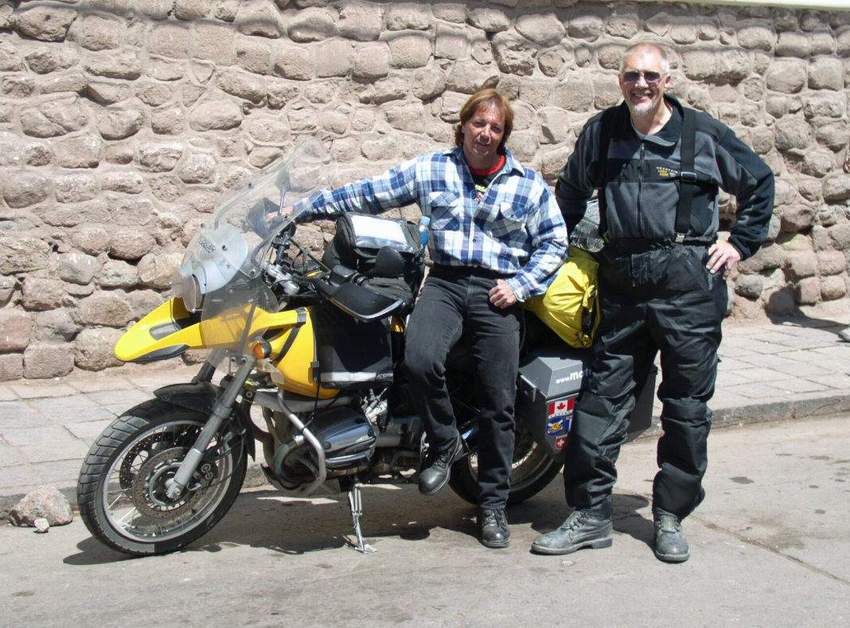 With
Daniel, I have a Peruvian breakfast of café con leche (one part very strong
coffee, three parts hot milk, and fill the rest of the cup with hot water) and a
breakfast roll with butter, and once more we discuss routes, lodging and
potential problems in our respective directions (we are each going where the
other is coming from.)
With
Daniel, I have a Peruvian breakfast of café con leche (one part very strong
coffee, three parts hot milk, and fill the rest of the cup with hot water) and a
breakfast roll with butter, and once more we discuss routes, lodging and
potential problems in our respective directions (we are each going where the
other is coming from.)
It takes an hour to pack the bike and since I can get US dollars out of the ATM
at the local bank with my debit card, I load up, not knowing whether I’ll be
able to change my Peruvian soles (the Peruvian currency) for Bolivian bolivianos
at the border, or how far it will be into Bolivia before I can get local
currency. You can change US dollars just about anywhere, so a good supply solves
many of your money problems.
Jeremy, part of the British contingent, tells me where I can get 95-octane gas
(equivalent to about 91 or 92-octane in the States, I believe, at least based on
how my bike runs on it) and I fill up at 13 soles per US gallon (USD $3.82 per
gallon) and head for Puno, my destination for the night.
To my question “a Puno?” and a hand gesture indicating the direction I’m headed,
a Transito Policia lady replies “si” and with a smile waves me east on Avenida
El Sol, a main street in Cusco that peters out in the suburbs to a gravel,
pot-holed mess. There are no signs; there never are, particularly leaving the
city. But I learned in Quito, following Ivan that even the Latin’s can’t find
their way in a strange city without stopping every few blocks to ask directions.
I do the same, but because of the language barrier, in much less sophisticated
fashion.
Using my final destination, if it’s not too far away, or an intermediate town if
it is, I stop the bike and say “a Pun?” (Meaning is this the road to Pun) and
wave my hand in the direction that I’m going or in the case of roundabouts,
where I think I should be going. Taxi and bus drivers are my target audience,
but in their absence, any old port in a storm. Anything much past “is,” left or
right is normally lost on me, so sometimes it’s a dozen such encounters to clear
the suburbs and land on the main road. That is true today, but with fewer
mistakes (I’m actually getting better at this) I clear Casco and its suburbs by
11am and I’m on my way.
 Pun
is 230 miles, and Daniel tells me that the bus takes six hours. He says the road
is excellent and that I could easily make it in four hours, although he took
six; stopping often to shoot pictures. My goal is Puno before dark, so I’ve got
six and a half hours to ride the 230 miles. That shouldn’t be a problem.
Pun
is 230 miles, and Daniel tells me that the bus takes six hours. He says the road
is excellent and that I could easily make it in four hours, although he took
six; stopping often to shoot pictures. My goal is Puno before dark, so I’ve got
six and a half hours to ride the 230 miles. That shouldn’t be a problem.
It’s village after village for the first fifty miles, and each slows me down
from the 55kph (34mph,) which nobody obeys, myself included. It’s Sunday and
there are markets in progress in many of the villages, but even though I want to
stop and take pictures, I need to make some time and pass on through.
The pavement is great, the villages fewer, so I start to make good speed (60 –
70mph) while watching for buses, pedestrians, bicycles, and animals of all kinds
in my lane. I stop in Sicuani for gas even though I’ve come only eighty-five
miles (and my tank will allow me about 220 miles) from Cusco. There is no lack
of gas stations in Peru, although some times 84-octane leaded is the only
choice, and my bike doesn’t like it, so I fill up whenever I just find at least
90-octane unleaded, particularly if I’m in rural areas.
 Just
past Sicuani I begin to ascend the pass that will top out at 4,312m (14,100’)
just before the pueblo of Santa Rosa. For the most part the mountains are old
and rounded and the valley wide, so in spite of the high altitude the road is
great, and at times I push the bike past 75mph. The miles are flying by at these
speeds, and I believe I’ll make Puno by 4pm, so I stop several times to take
pictures. Fifty kilometers (30 miles) past the high pass at Santa Rosa I come
upon a scene so beautiful that I stop for thirty minutes and write the following
text.
Just
past Sicuani I begin to ascend the pass that will top out at 4,312m (14,100’)
just before the pueblo of Santa Rosa. For the most part the mountains are old
and rounded and the valley wide, so in spite of the high altitude the road is
great, and at times I push the bike past 75mph. The miles are flying by at these
speeds, and I believe I’ll make Puno by 4pm, so I stop several times to take
pictures. Fifty kilometers (30 miles) past the high pass at Santa Rosa I come
upon a scene so beautiful that I stop for thirty minutes and write the following
text.
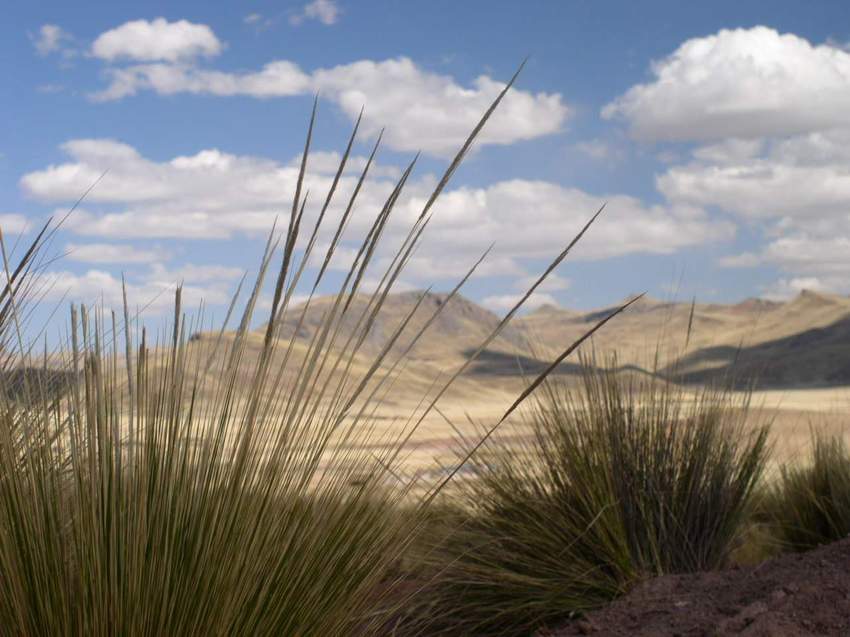
These are the mountains and buttes of eastern Oregon, of southern Idaho and
northern Utah, except this valley is well over 12,000’ high. Grass the hue of
ripe wheat covers the fields and nearby hills. Ragged cotton balls of white
clouds, in sharp contrast to the deep blue background, hang directly above me.
At this high altitude the sky seems close enough to touch; sometimes alarmingly
so.
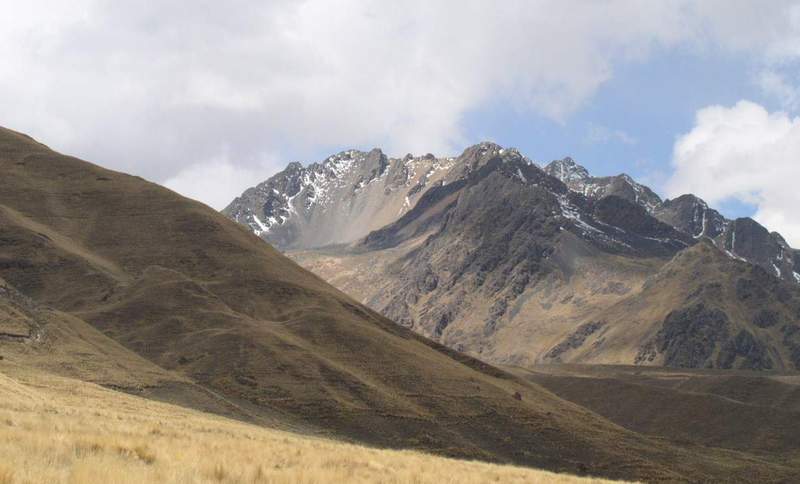
The Andes are old here, broad shoulders of mountains rounded by the eons,
although a few buttes and rocky peaks hold out against the inevitable softening
of future erosion; which in this dry landscape it will take many centuries.
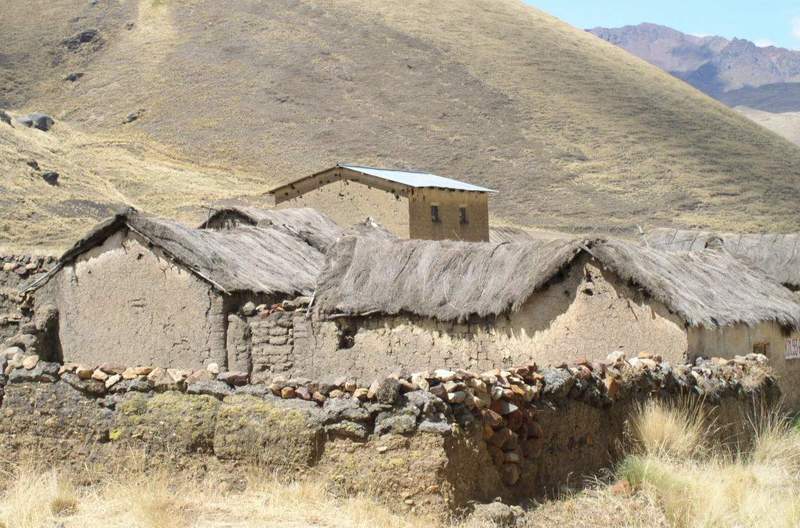
In the distance a scattering of adobe farm houses dot the landscape while a
small herd of cattle marches in single file to a watering hole; almost dry now.
At over 12,000’ the sun beats down mercilessly and only the breeze picking up
allows me to continue writing.
Two kids push their bikes up the hill past my bike, and a scruffy black dog,
looking much the worse for wear, appears from nowhere. He sits contentedly a few
feet away, lunch clearly on his mind, but he doesn’t pursue it aggressively. I
wrap up my writing, pull out a chocolate bar and a bottle of water for lunch and
toss the last half of the chocolate to the scruffy dog. He gulps it down.
I swing my leg back over the saddle, replace the camera and writing pad, hit the
start button and as I release the clutch, gain the highway. Every detail of
the nearby hills stands out in vivid relief from the penetrating sun, so close
overhead.
Another hour goes by when I pass two motorcyclists who indicate with hand
signals that everything is fine. Five miles down the road I meet their
companion, pulled off the road, waiting. I stop. They are from the Brazilian
capital of Brazilia, and are touring Bolivia and Peru as well as their native
country. With best wishes shared, I’m back on the road.
 Fifteen
miles from the town of Juliaca, two bicyclists are headed west – on the opposite
shoulder, and we stop to chat. Ryan Parton is from Vancouver Island, B.C., and
is seven months north of Tierra del Fuego. His friend, Kris Halderson from
Winnipeg, has joined him for six weeks. I explain that a Swiss couple with a
similar itinerary is two weeks ahead of them. They decline the water I offer
them, but I provide the miles and road conditions to the next village, where
they plan to pitch their tent for the night. We bid each other good wishes and
are on our respective ways.
Fifteen
miles from the town of Juliaca, two bicyclists are headed west – on the opposite
shoulder, and we stop to chat. Ryan Parton is from Vancouver Island, B.C., and
is seven months north of Tierra del Fuego. His friend, Kris Halderson from
Winnipeg, has joined him for six weeks. I explain that a Swiss couple with a
similar itinerary is two weeks ahead of them. They decline the water I offer
them, but I provide the miles and road conditions to the next village, where
they plan to pitch their tent for the night. We bid each other good wishes and
are on our respective ways.
In all honesty, the police in both Ecuador and Peru have been on their very best
behavior during this trip. Thirty miles past the Ecuador/Peru border I was
stopped for a passport, tourist card and transit pass (for the bike) check, but
in spite of police stops in nearly every village and town, I’ve always been
waived through.
This checkpoint is different. At least a half dozen officers, with both
motorcycles and cars, stop everyone. Nobody is waived through. I stop as ordered
and produce my passport and transit card. The officer, in full uniform, helmet
and jack boots, addresses me in rapid-fire Spanish. Although I tell him several
times that I don’t speak the language, each time my protests are met with
another two minutes of haranguing. While I understand few of the words he
speaks, his meaning is becoming crystal clear.
He points back down the road I’ve just come and pulls out his ticket book. It’s
obvious that I’m about to get a speeding ticket, even though the police are not
running radar and I saw the control point a half mile back, immediately reducing
my speed to about 30mph, below the legal limit.
Repeatedly I ask him to return my passport, which he does (a rookie mistake on
his part, I believe,) but then requests my license. I hand him the Washington
license (since cancelled) from my false wallet, and he then requests my
International Drivers License. I produce it. He points to my headlight as
another infraction. My original Washington drivers license is safely tucked away
in my primary wallet, and you can obtain an International drivers license at any
AAA office in the States for $15 and a Cheerios box top, so he has nothing of
value.
Now I’m normally contrite with foreign police, who have the power to lock me up,
but the return of my passport has emboldened me, and quite frankly, I’m irate
about the trumped-up charges. Both the speeding and headlight charge are totally
bogus. “No, no, no,” I shout, pointing at the headlight, and shaking my head
vigorously from side to side.
He orders me off the road towards his parked motorcycle, about the size of my
luggage carriers, I mentally note with scorn. Repeatedly he points to his gas
tank and to mine, and with his fingers demands money.
Obviously this is not a ticket; rather, an outright shakedown. However, it’s
gone on for about fifteen minutes. I demand the return of my cancelled license,
and amazingly he returns it. I don’t give in to his demands for money. A few
more minutes pass, with us at a stalemate, and then he smiles and says, “OK.” I
re-start my bike, not knowing if I’ll be allowed to leave, but he holds out his
hand, which I shake. He smiles and I slowly pull away.
A mile further down the highway I pull off the road to collect myself and settle
my frayed nerves.
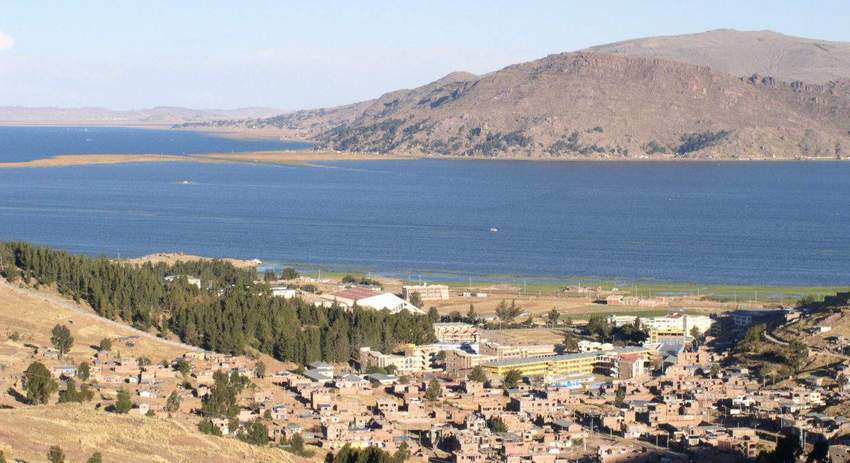 Twenty
miles later I stop where the highway begins its short decent into Puno. It’s my
first view of Lake Titicaca at 3,812m (12,500’) one of the highest navigable
lakes in the world. In the intense sunlight at this altitude, and over a mile
away, the lake is as blue as anything I’ve ever seen.
Twenty
miles later I stop where the highway begins its short decent into Puno. It’s my
first view of Lake Titicaca at 3,812m (12,500’) one of the highest navigable
lakes in the world. In the intense sunlight at this altitude, and over a mile
away, the lake is as blue as anything I’ve ever seen.
This will be lost on some of you, clear as crystal to others, but as a kid
growing up in the 60s, there was always some classmate who painted a dozen coats
of lacquer on his ’57 Chevy, then polished it off with another dozen coats of
Simonize. You seemed to look three inches deep into the finish. Lake Titicaca is
that depth of blue.
With Lonely Planet as my guide I find a suitable hotel, then ride the Beemer up
two steps into the lobby. Another day on the road in South America.
