Cusco, Peru
September 1, 2004
Nazca to Cusco
 In
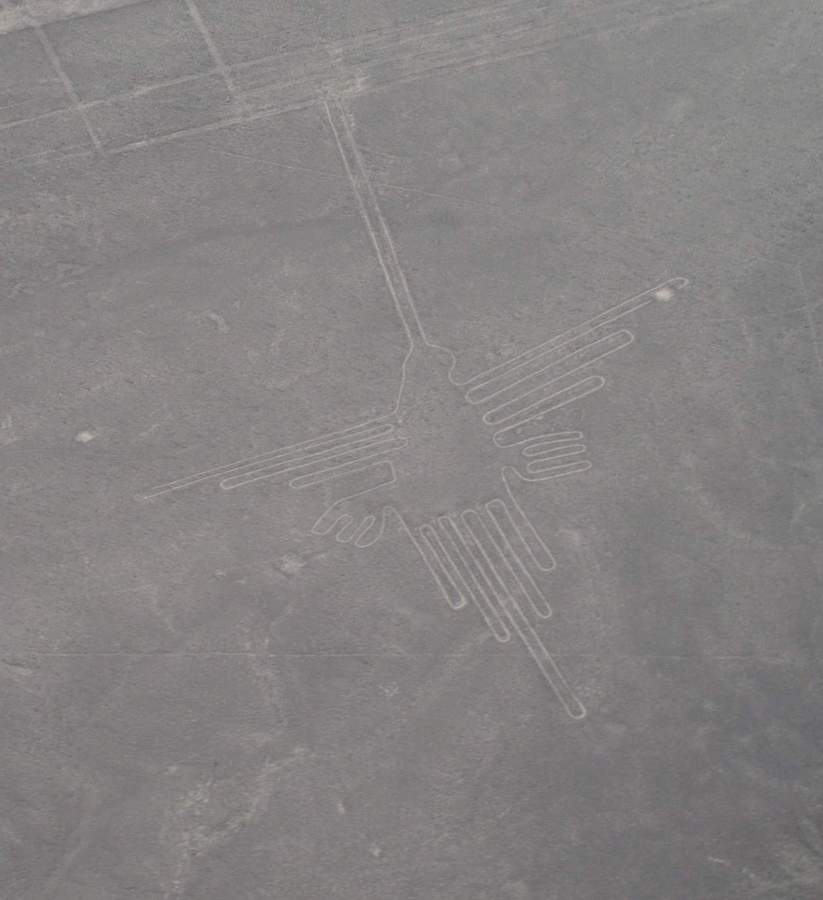
Huaraz it’s the Cordillera Blanca, in Nazca it’s the Lines (Nazca Lineas,) huge
geometric designs the length of a football field, and which include a monkey,
hummingbird, hands, a flower and a killer whale among the many. There are lines
and trapezoidal figures so straight they surely must have been laid out using a
laser beam; built by removing the dark surface rocks and thereby exposing the
lighter-colored gypsum that lies underneath. While not many scientists agree on
their purpose, there appears to be general agreement that dates their origin to
a period between 900BC and 600AD. Some speculate that they represent an
astronomical calendar, others that they have religious significance, and still
others that they are evidence of extraterrestrial visitation on earth.
In
Huaraz it’s the Cordillera Blanca, in Nazca it’s the Lines (Nazca Lineas,) huge
geometric designs the length of a football field, and which include a monkey,
hummingbird, hands, a flower and a killer whale among the many. There are lines
and trapezoidal figures so straight they surely must have been laid out using a
laser beam; built by removing the dark surface rocks and thereby exposing the
lighter-colored gypsum that lies underneath. While not many scientists agree on
their purpose, there appears to be general agreement that dates their origin to
a period between 900BC and 600AD. Some speculate that they represent an
astronomical calendar, others that they have religious significance, and still
others that they are evidence of extraterrestrial visitation on earth.
What’s so strange about the Lines is that they are impossible to discern from
the ground. So, like all tourists that come to Nazca, I make arrangements for a
forty-five minute flight to view them from the air. The designs are really quite
extraordinary, although from one thousand feet up, I’m quite sure that my
pictures won’t do them justice.
 It’s
a long, steep climb out of Nazca to begin the trip to Cusco some 400 miles away,
and as the Panamericana Sur leads south to Arequipa, while this is a paved road,
it is far from the principal road. In fact, ending just five years ago, this
highway was extremely dangerous as the Shining Path guerillas, a leftist group,
terrorized tourists and locals alike with robbery, kidnapping and murder
throughout the late-1980s and 1990s. However, their leader, a philosophy
professor at a Peruvian university, was captured and the band subsequently
disintegrated. Lucky for me.
It’s
a long, steep climb out of Nazca to begin the trip to Cusco some 400 miles away,
and as the Panamericana Sur leads south to Arequipa, while this is a paved road,
it is far from the principal road. In fact, ending just five years ago, this
highway was extremely dangerous as the Shining Path guerillas, a leftist group,
terrorized tourists and locals alike with robbery, kidnapping and murder
throughout the late-1980s and 1990s. However, their leader, a philosophy
professor at a Peruvian university, was captured and the band subsequently
disintegrated. Lucky for me.
I’m about thirty miles out of Nazca when I start to doubt my direction. Since I
don’t carry a GPS, I rely on my (very poor) map, locals pointing the way, and my
generally reliable sense of where I am, but the sun is shining over my left
shoulder, which in the States in the early afternoon means that you’re headed
west. The route is so circuitous that I’m sure it will turn around as it works
its way across the mountains, but it never does. At about forty miles I stop to
consider my options.
 There
are only three roads out of Nazca. One goes to Lima – the way I entered the
town, and I know that I’m not backtracking to Lima. A second heads south to the
coast and on to Arequipa. That’s the Panamericana, as I just mentioned. The
third goes to Cusco. By the side of the road I check my compass. Strangely
enough, when I align the pointer with north, I’m going due west, and that’s
certainly not the direction of Cusco. But I also know that I can’t be headed to
Arequipa because that road goes down to the coast, and I’m clearly climbing high
into the mountains.
There
are only three roads out of Nazca. One goes to Lima – the way I entered the
town, and I know that I’m not backtracking to Lima. A second heads south to the
coast and on to Arequipa. That’s the Panamericana, as I just mentioned. The
third goes to Cusco. By the side of the road I check my compass. Strangely
enough, when I align the pointer with north, I’m going due west, and that’s
certainly not the direction of Cusco. But I also know that I can’t be headed to
Arequipa because that road goes down to the coast, and I’m clearly climbing high
into the mountains.
I’m really quite perplexed until it occurs to me that I’m in the southern
hemisphere, perhaps one thousand miles south of the Equator. Please bear with me
as I work through the logic. In the dead of winter in the Far North, Fairbanks,
Alaska as an example, the sun barely rises over the southern horizon. So, much
farther south than I am now, even two months past the winter solstice, it would
lie low on the northern horizon. Then even one thousand miles south of the
Equator, if the sun is not shining directly overhead, it should be to the north
of me. Now I realize that my compass is pointing to the South Pole, not the
North, and so the sun is properly in the north. It should be on my left shoulder
if I’m headed east.
 [Note:
I got to Cusco, so I was on the right road. I hope my logic is correct, or I’ve
just made a real fool of myself in front of fifty of my closest friends and
family.]
[Note:
I got to Cusco, so I was on the right road. I hope my logic is correct, or I’ve
just made a real fool of myself in front of fifty of my closest friends and
family.]
I flip up the kickstand, alternate clutch and gear shifter through four gears
and continue on the hundred miles of twisting road to Puqio, my intermediate
destination on the road to Cusco.
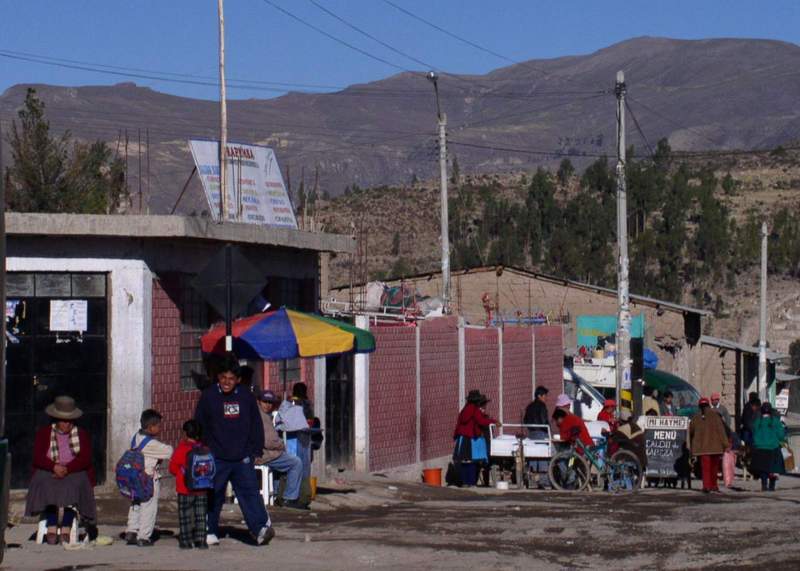
Puqio is a very small town; really more of a large village, and even Lonely
Planet holds out little hope for acceptable lodging, but lists “the basic”
Hostal Los Andes. As I enter town the pavement turns to a rutted, pot-holed
street, and when I ask for the Hostal Los Andes I’m led to it; almost next-door.
 An
entry through the barred door leads to a small courtyard, hardly ablaze in
flowers, but with a plant here and there, and acceptable for Puqio. The
proprietor, I don’t get his name, indicates that there is a room available,
secure parking for my bike, and leads me upstairs where a dozen rooms are off a
balcony over the garage below. I like the setup, particularly line of sight to
the bike, follow the proprietor to the room, notice the shower and bathroom in
the room and decide that I’ll stay. Quite frankly, it’s nicer than I expect to
find.
An
entry through the barred door leads to a small courtyard, hardly ablaze in
flowers, but with a plant here and there, and acceptable for Puqio. The
proprietor, I don’t get his name, indicates that there is a room available,
secure parking for my bike, and leads me upstairs where a dozen rooms are off a
balcony over the garage below. I like the setup, particularly line of sight to
the bike, follow the proprietor to the room, notice the shower and bathroom in
the room and decide that I’ll stay. Quite frankly, it’s nicer than I expect to
find.
“Cuanto questo,?” I ask, inquiring of the price. “Viente,” he replies, and I
recoil in mock horror. “Viente!” We move back downstairs. “Viente” I say again,
“no, quince.” There’s a long pause and then he agrees. “Quince.”
 Well
I immediately feel like a real heel for negotiating the price down from $7 to
$5, but unpack the bike, secure my gear in the room and then walk into the
village in hopes of finding dinner.
Well
I immediately feel like a real heel for negotiating the price down from $7 to
$5, but unpack the bike, secure my gear in the room and then walk into the
village in hopes of finding dinner.
It’s only on my return from this sleepy little village when I realize that the
toilet seat, shower curtain and towels apparently weren’t part of the deal. The
room is painted and the floor is spotless, but I roll out my sleeping bag across
the covers as a preventive measure. As you probably suspected, in Puqio there is
no 3-star alternative. $2, indeed!
On
to Cusco
 It’s Tuesday morning and after an early start I’m making good time on the great
road that has started at Puqio. Fifty miles and barely an hour into my morning
ride, I’m high on an Andean pass that reaches 4,300m (14,061’) on my way to
Chalhuanca, the next village on my way. There is a beautiful desolation in these
mountains, but it is bitter cold, and I stop to add my winter gloves and Gerbing
heated jacket (it operates from my bike accessory plug, a fairly common bike
accessory, for you non-motorcyclists.) I’m shaking as I change clothes, it’s so
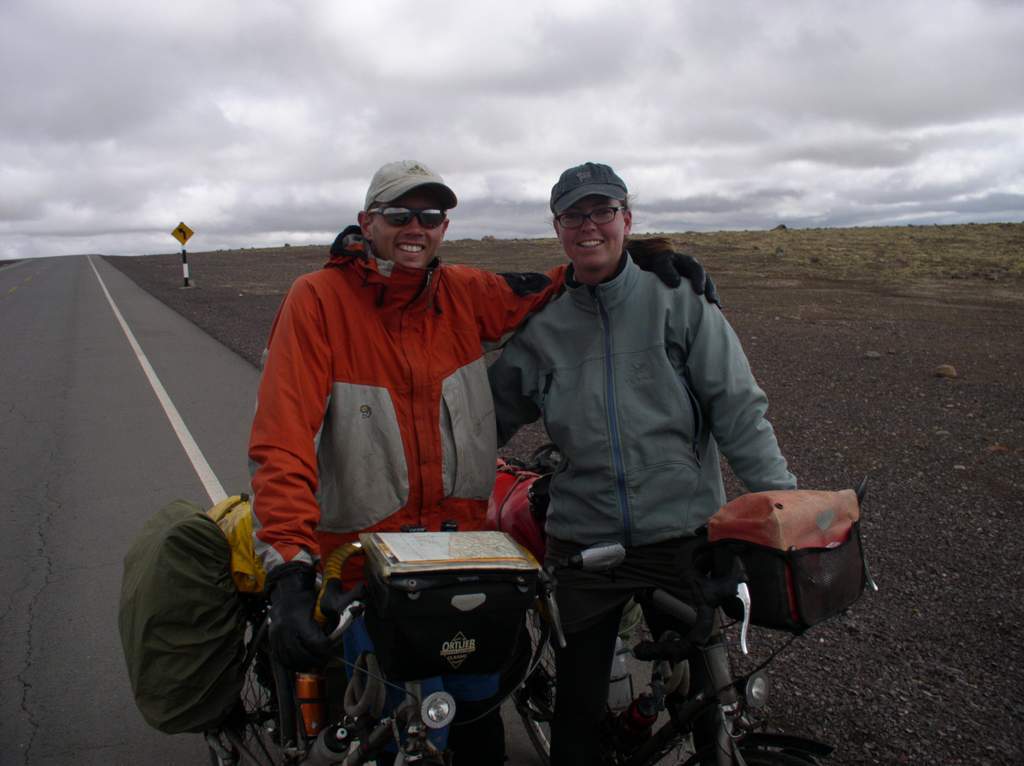
cold; and barely underway when I spot two bicycles ahead, going west. Miriam and
Philippe, young Swiss riders are seven months north of Tierra del Fuego and
headed for Prudhoe Bay, Alaska, my trip in reverse. They anticipate that they’ll
arrive at the Arctic Ocean in a year. Once again, I’m humbled.
It’s Tuesday morning and after an early start I’m making good time on the great
road that has started at Puqio. Fifty miles and barely an hour into my morning
ride, I’m high on an Andean pass that reaches 4,300m (14,061’) on my way to
Chalhuanca, the next village on my way. There is a beautiful desolation in these
mountains, but it is bitter cold, and I stop to add my winter gloves and Gerbing
heated jacket (it operates from my bike accessory plug, a fairly common bike
accessory, for you non-motorcyclists.) I’m shaking as I change clothes, it’s so
cold; and barely underway when I spot two bicycles ahead, going west. Miriam and
Philippe, young Swiss riders are seven months north of Tierra del Fuego and
headed for Prudhoe Bay, Alaska, my trip in reverse. They anticipate that they’ll
arrive at the Arctic Ocean in a year. Once again, I’m humbled.
