Puerto Natales, Chile
December 31, 2004
Tierra del Fuego
Ushuaia
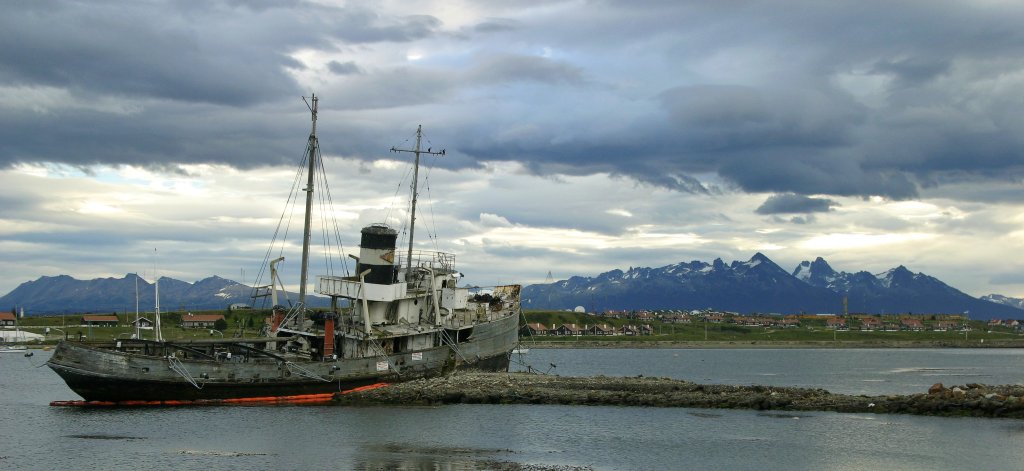 With it’s location at the end of the road system in the Americas, Ushuaia lays
claim to the position of the furthest south city in the hemisphere; for that
matter, in the world. In truth though, the Chilean town of Puerto Williams, much
smaller and just south across the Beagle Channel, is both further south and on a
road as well, although you must get there by ferry. Of course you must cross the
Straits of Magellan by ferry to reach Ushuaia too, but I’m splitting hairs here.
Ushuaia has won the public relations war, and that’s all that counts. So we all
take our pictures by the sign that says “end of Route 3” and call it good.
Alaska to Ushuaia; from the top to the bottom.
With it’s location at the end of the road system in the Americas, Ushuaia lays
claim to the position of the furthest south city in the hemisphere; for that
matter, in the world. In truth though, the Chilean town of Puerto Williams, much
smaller and just south across the Beagle Channel, is both further south and on a
road as well, although you must get there by ferry. Of course you must cross the
Straits of Magellan by ferry to reach Ushuaia too, but I’m splitting hairs here.
Ushuaia has won the public relations war, and that’s all that counts. So we all
take our pictures by the sign that says “end of Route 3” and call it good.
Alaska to Ushuaia; from the top to the bottom.
The city itself, with a population between 30,000 and 40,000, is a strange mix
of last frontier boomtown and tourist trap. You can buy a new Chrysler or Honda
car here, or at All Patagonia Tours book your passage on a Russian icebreaker to
Antarctica. You can dodge logging trucks on Ruta 3 in the outskirts, while
downtown on Avenida San Martin never be more than a block from a store that
sells Kodak film. Hamburg Sud and Maersk Sealand containers jam the bustling
port while cruise ships the size of small towns disgorge tourists by the
thousands.
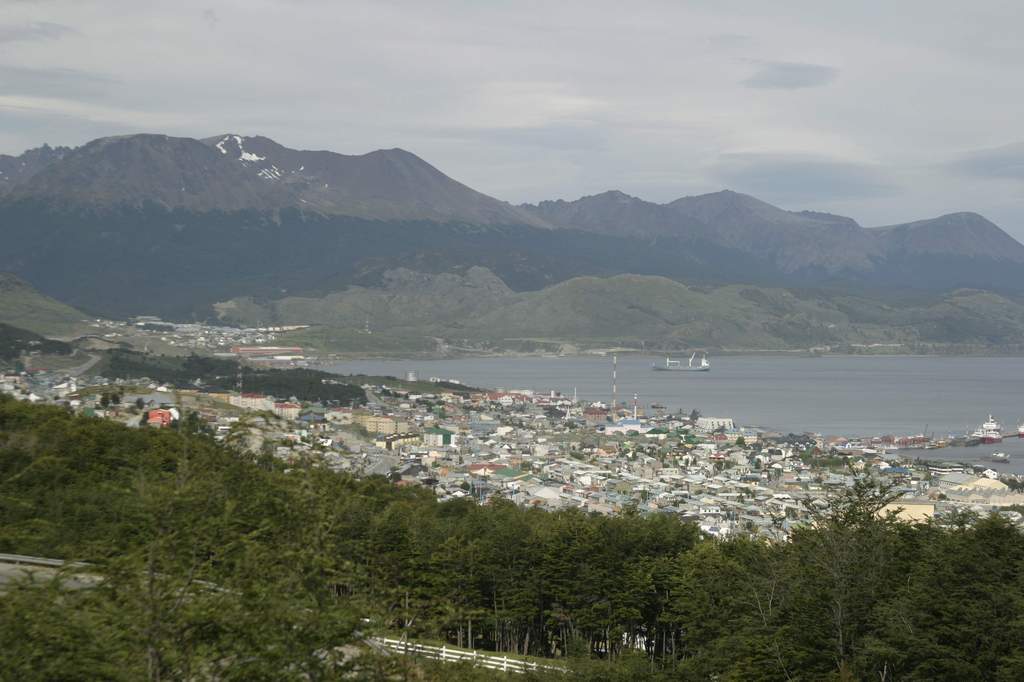 This contradiction named Ushuaia occurs in an exquisite natural setting. Houses
and businesses step up hills adjoining the frigid waters of the Beagle Channel,
named for Charles Darwin’s ship as he traversed the area in the 1820s on his way
to the Galapagos Islands. Vegetation adorns the lower slopes, but gives way to
snow in gullies and bowls as scree slides fall from jagged peaks. Truth be told,
the physical setting is more like south central Alaska that any other place that
I’ve visited. These are the Chugach Mountains that rise behind Anchorage,
Whittier and Valdez, and the young, wild and sharp Talkeetnas, just north of the
Matanuska Valley. To be sure, Ushuaia is in a beautiful spot.
This contradiction named Ushuaia occurs in an exquisite natural setting. Houses
and businesses step up hills adjoining the frigid waters of the Beagle Channel,
named for Charles Darwin’s ship as he traversed the area in the 1820s on his way
to the Galapagos Islands. Vegetation adorns the lower slopes, but gives way to
snow in gullies and bowls as scree slides fall from jagged peaks. Truth be told,
the physical setting is more like south central Alaska that any other place that
I’ve visited. These are the Chugach Mountains that rise behind Anchorage,
Whittier and Valdez, and the young, wild and sharp Talkeetnas, just north of the
Matanuska Valley. To be sure, Ushuaia is in a beautiful spot.
It’s the beauty, certainly, but more surely the “end of the road” allure that
brings long-distance motorcycle riders here each year between Christmas and New
Year. This is a tradition of some years standing now; and one that seems to grow
as time passes. By Christmas at least thirteen of us have arrived, although
another two riders are in town that I haven’t yet met.
Ricardo, on a BMW like mine, has flown his bike in from Italy. Tony, on the road
now for over two years is from Manchester, England, and David’s from London on a
BMWF650. Peter and Jess, friends I wrote about when I first met them in Quito,
are teachers from the Lake District in England, and at the end of their yearlong
tour that included Alaska. Jesse is on her own Kawasaki KLR250 now, a bike she
bought in Lima, while Peter’s Honda Dominator is still causing problems, as it
did in Ecuador. He’s had bad luck with the Dominator. We’re happy to see each
other again after five months.
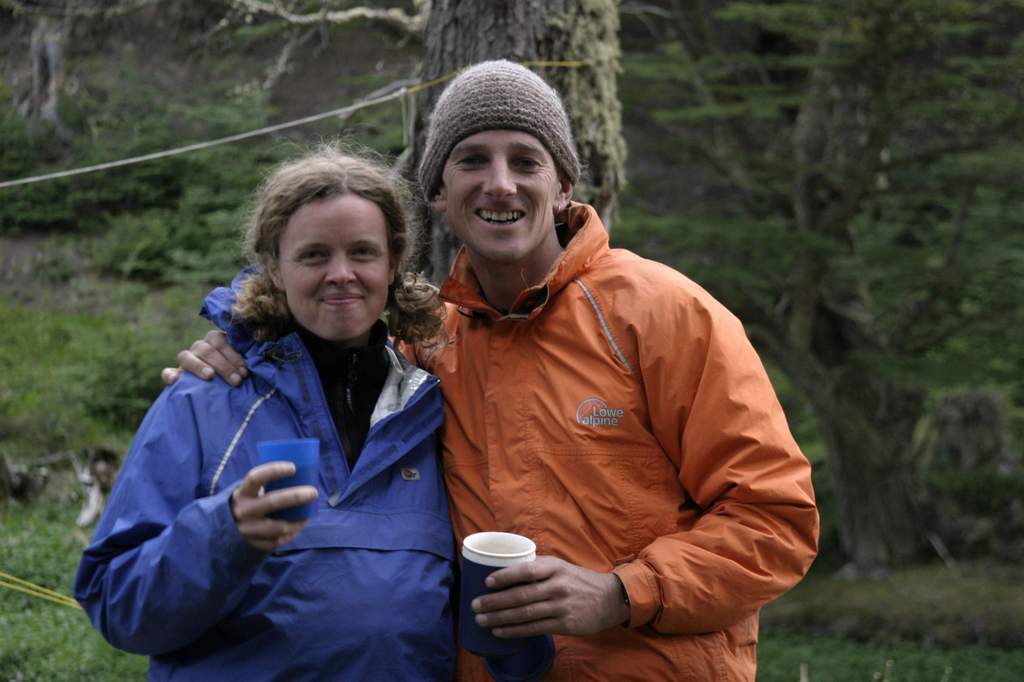 John is many months riding an old BMW 1000 down from British Colombia. His
lovely girlfriend Sara has joined him. He’s a professional photographer.
Christian and Heiki, who both work for the German Railroad system, are at the
end of seven months in South America. There is a couple from Switzerland, two-up
on a KTM. Finally, John, a teacher from Nebraska, has been on the road for 2 ½
years, in what started out as a trip to Alaska on his Suzuki 650. He attended a
Horizons Unlimited traveler’s meeting that I was at in Revelstoke, British
Columbia in September 2003, on his way back from Alaska. He says that he got so
excited at the gathering, that instead of returning to Nebraska, he simply
headed south to Mexico and Central America. He’s been on the road ever since.
John needs some dental work done and says that he may ride up to Columbia for
that purpose. He’s living on less than USD$5 per day (not including gasoline)
and he believes that the work would be good, and much cheaper there. I complete
the American contingent, but with a much shorter resume, I might add.
John is many months riding an old BMW 1000 down from British Colombia. His
lovely girlfriend Sara has joined him. He’s a professional photographer.
Christian and Heiki, who both work for the German Railroad system, are at the
end of seven months in South America. There is a couple from Switzerland, two-up
on a KTM. Finally, John, a teacher from Nebraska, has been on the road for 2 ½
years, in what started out as a trip to Alaska on his Suzuki 650. He attended a
Horizons Unlimited traveler’s meeting that I was at in Revelstoke, British
Columbia in September 2003, on his way back from Alaska. He says that he got so
excited at the gathering, that instead of returning to Nebraska, he simply
headed south to Mexico and Central America. He’s been on the road ever since.
John needs some dental work done and says that he may ride up to Columbia for
that purpose. He’s living on less than USD$5 per day (not including gasoline)
and he believes that the work would be good, and much cheaper there. I complete
the American contingent, but with a much shorter resume, I might add.
Most are camped, although several of us are in hostals. We are of different
means and backgrounds, and from a half-dozen different countries, but we meet
daily to trade stories of past trips and future itineraries and to seek
companionship. It’s a varied group, to be sure, but one with great camaraderie.
We’ve each seen a lot of the world from the back of a motorcycle.
 Heading north
It’s raining as I leave Ushuaia on Wednesday morning, and although I’ve enjoyed
my four days of rest and relaxation, I’m happy to be back on the road. At the
town of Tolhuin (site of my flat tire) a German couple that are headed south
follow me into the gas station. A rider from Buenos Aires on a Honda Africa Twin
is riding with them. All three are headed to Ushuasia for the New Year
celebration. When I exit Argentina at the San Sebastian border crossing two
Brazilian couples, one two-up on a very uncomfortable-looking Yamaha sport bike
are headed south as well. We trade pictures, and I provide a map to the
campsite. Frederic, who I met in Azul, is on his way. Luca, from Italy and whom
I met in Las Grutas will be here as well. I’ve been in e-mail contact with each.
It will be a big group ringing in 2005 in Ushuaia.
Although it’s been cool in Ushuaia, in the high 50s and low 60s, the surrounding
mountains have provided a respite from the perpetual winds of Patagonia and
Tierra del Fuego. For the seven days that I spent on Ruta 3 riding down from
Buenos Aires, only the first day to Azul and the layover day in Las Grutas were
calm. Otherwise, I got battered every day; although some days were a little
better than others. So it’s disheartening that I’m only 60 miles (100km) north
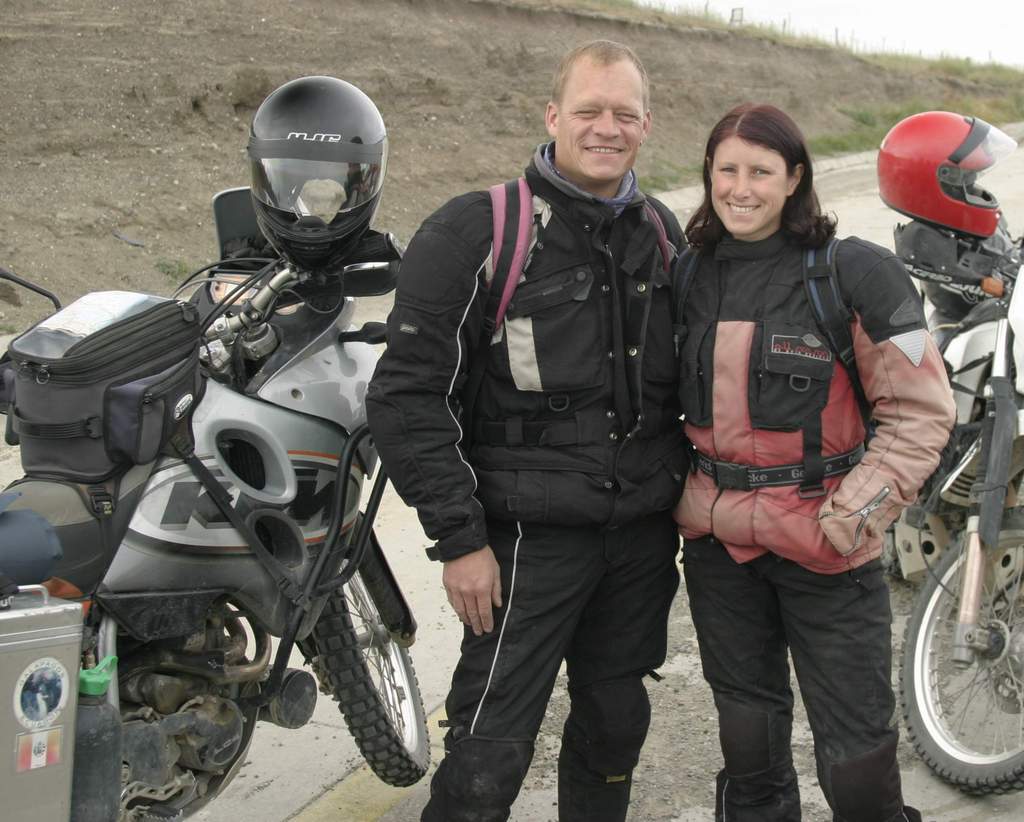
of Ushuaia when it starts again. Christian and Heiki, the German couple riding
to Buenos Aires to ship their bikes home, catch up to me at the Argentina/Chile
border crossing at San Sebastian. It is positively howling by then, and it
continues across the 80 miles (130km) of gravel to the village of Cerro
Sombrero, Chile, where we spend the night and share dinner together.
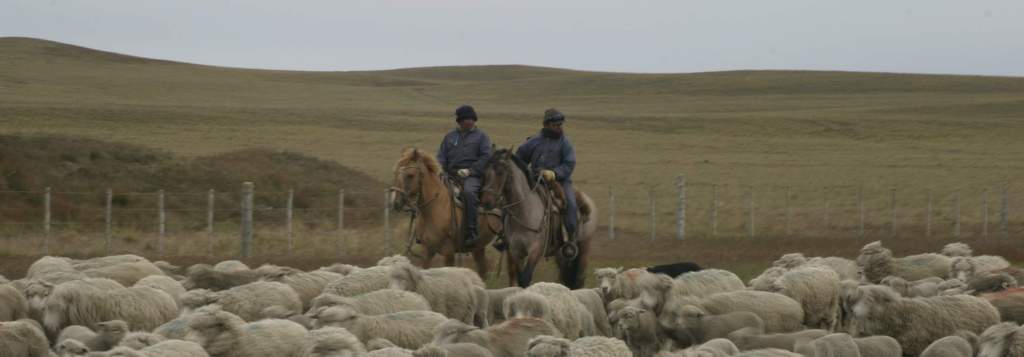
 Thursday morning, though, dawns clear and calm. The grasslands of Tierra del
Fuego roll out before us like tan-colored velvet bathed in the morning sun. The
Straits of Magellan are calm when the ferry carries us back to the mainland. We
say our goodbyes and they head north up Ruta 3 while I roll west toward Puerto
Natales. The road surface is excellent and wildflowers provide contrast to the
straw-colored landscape. It’s noon when I stop for the gas in the pueblo of
Cabeza del Mar, and a wonderful day. However, when I remount the bike for the
two-hour ride to Puerto Natales, the wind has started. It’s a howling hurricane
before I arrive.
Thursday morning, though, dawns clear and calm. The grasslands of Tierra del
Fuego roll out before us like tan-colored velvet bathed in the morning sun. The
Straits of Magellan are calm when the ferry carries us back to the mainland. We
say our goodbyes and they head north up Ruta 3 while I roll west toward Puerto
Natales. The road surface is excellent and wildflowers provide contrast to the
straw-colored landscape. It’s noon when I stop for the gas in the pueblo of
Cabeza del Mar, and a wonderful day. However, when I remount the bike for the
two-hour ride to Puerto Natales, the wind has started. It’s a howling hurricane
before I arrive.
