Ushuaia, Tierra del Fuego, Argentina
December 28, 2004
Ruta 3 – to Ushuaia
On to Rio Gallegos
Camarones is right on the ocean, and protected from the winds that makes
themselves felt inland, at slightly higher elevations. So I’m a few miles down
the road toward Ruta 3 before I experience the full fury. Even at that, it is
hitting me squarely on the nose of the bike, mitigating the handling problem. I
turn south on Ruta 3, with my right side to the very high velocity and continue
south to Comodora Rivadavia. Though sometimes a struggle to control the bike, I
cover the 170 miles (300km) by 3pm and stop for a late lunch, and to make a
decision. I clearly haven’t covered enough miles to stop for the day, but the
conditions are very bad. The next town south where I will be able to find a
hotel is Puerto San Julian, another 270 miles. Even in the high winds I’ve been
averaging about over 60mph (100kph) so I should be able to cover that in just
over four hours. I should be in at 8pm, and it’s light at this latitude (and
just past the summer solstice) until 9:30am. I push forward, again checking the
tires.
While there is a fair amount of traffic, particularly big trucks, there are few
settlements and not much gas. Lonely Planet lists Patagonia’s population density
at one of the lowest in the world. My mantra while riding in foreign countries
is to “get gas often and early.” At 35 miles to the gallon, I have a theoretical
range of about 210 miles (350km) on my BMW. Under ideal conditions, that number
jumps to 240 miles (400km) or higher. Unfortunately, my tank shows empty at 165
miles (300-km). Although I believe the theoretical calculations, driving with a
“gas low” light on drives me crazy.
 I pass on gas at Caleta Olivia because I just have 50 miles (80km) on the tank,
and from my map, there is a major intersection another 50 miles down the road at
Fitz Roy or Jaramillo. But Fitz Roy is a dry hole. There are a couple of houses,
but nothing resembling commercial development. I continue on to Jaramillo,
another 15 miles.
I pass on gas at Caleta Olivia because I just have 50 miles (80km) on the tank,
and from my map, there is a major intersection another 50 miles down the road at
Fitz Roy or Jaramillo. But Fitz Roy is a dry hole. There are a couple of houses,
but nothing resembling commercial development. I continue on to Jaramillo,
another 15 miles.
I’ll make this story short, as it is really nothing more than an interesting
anecdote. When I drive the four miles (7km) off the road to buy gas in
Jaramillo, I’m met with nothing more than a rerun of Fitz Roy. I’m still 170
miles from Puerto San Julian, and have no guarantee of gas on Ruta 3. Quite the
opposite, actually, as I’m told that there is no gas before Puerto San Julian. A
local resident confirms that my best option is the local police, but they have
none to sell. They do, however, send me to the city offices, where I’m given
eight liters and sent on my way with a smile. As is normal with Argentine
(actually, South American) hospitality, they won’t accept payment. Gosh, am I in
debt to these folks, or what? While back on the road with a gas tank that’s
nearly full, I’ve lost an hour.
As I head south to Puerto San Julian, the wind reaches gale force. I have no way
of measuring it, but my best guess is a sustained velocity of 50 mph or higher,
with frequent gusts. The bike is constantly heeled over at 20 degrees or more,
and at times I’m looking over the left-hand corner of the windscreen. Gusts blow
me from the right to the left track of the right lane, as I fight to get back
over. Often a decrease in velocity, alone, is enough to move the bike back
there. The wind tears at my helmet and riding jacket. It is literally trying to
pull the helmet off my head, up and to the left. Only the chinstrap negates its
efforts. The engine noise from the motorcycle, quiet to begin with, is simply
lost in the howl, which is deafening. When gusts hit, the howl temporarily
becomes a high-pitched whine. The noise is overwhelming.
 About an hour or two north of Puerto San Julian, I catch up to three
motorcyclists. They are struggling mightily, heeled to the right, and being
blown back and forth across the right-hand land. Based on the size, their bikes
are around 650cc, and so easily 200 pounds (90 kilos) lighter than mine. I’m
getting beat up badly, but they are getting absolutely punished. When I finally
pass them and wave as I do so, they are so intent on the conditions, that nobody
looks up. The wind never abates for the four hours from Jaramillo to Puerto San
Julian, where I get a motel by the highway around 10am in failing light. Simply
exhausted from the riding I crash into bed and don’t wake until after noon on
Thursday.
About an hour or two north of Puerto San Julian, I catch up to three
motorcyclists. They are struggling mightily, heeled to the right, and being
blown back and forth across the right-hand land. Based on the size, their bikes
are around 650cc, and so easily 200 pounds (90 kilos) lighter than mine. I’m
getting beat up badly, but they are getting absolutely punished. When I finally
pass them and wave as I do so, they are so intent on the conditions, that nobody
looks up. The wind never abates for the four hours from Jaramillo to Puerto San
Julian, where I get a motel by the highway around 10am in failing light. Simply
exhausted from the riding I crash into bed and don’t wake until after noon on
Thursday.
(Note: I guess the obvious question is why didn’t I stop. Certainly the
conditions were unsafe, and riding was hazardous. My answer is that in
Patagonia, the winds can howl like this for weeks at a time. Stopping may work,
but also may not. Also, the land is so flat, that there is virtually no place to
stop to get out of it. At times, I did slow to as little as 40mph.)
 The winds are still high, but much better on Thursday, and I easily make the 240
miles (300km) into Rio Gallegos by early evening.
The winds are still high, but much better on Thursday, and I easily make the 240
miles (300km) into Rio Gallegos by early evening.
When I again inspect the front tire on Friday morning, I decide that it has at
least another 1,000 miles (1,600km) of life left. The back tire, though, looks
pretty well done, and I decide to change it. In over and hour I find four
garages that could change it, but just don’t have time. At the fourth garage I
ask the manager for an opinion, and he assures me that I’ll make the 350 miles
(600km) to Ushuaia without a problem. I’m skeptical, but the pavement has been
excellent so far. There appears to be about 100 miles of gravel in this upcoming
section, but as quickly as things are changing down here, I’m hoping that it
might be paved. I can’t get a confirmation one-way or the other.
The final push to Ushuaia
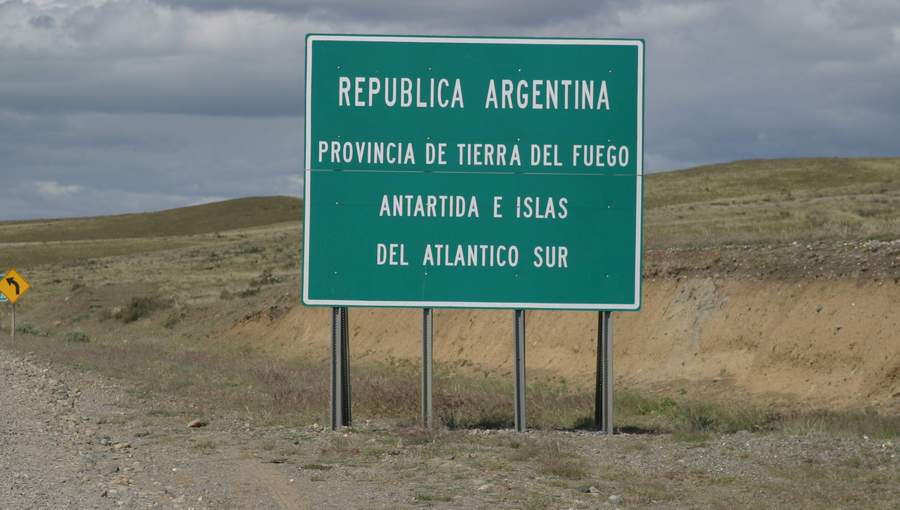
To reach Ushuaia, you must clear Argentine customs, enter Chile and cross the
Straits of Magellan by ferry to reach the island of Tierra del Fuego. For 100
miles (160km) you traverse Chile, and then cross back into Argentina for the
final 150 miles (250km) to Ushuaia. Just south of Rio Gallegos, the wasteland
that is eastern Patagonia turns into semi-arid rolling grassland. This is the
home of enormous estancias (sheep ranches). The Italian clothes maker Benetton
has one such estancia that I’ve seen quoted as 177,000 hectares. If my math is
correct, that’s an incredible 437,000 acres.
I drive five miles (8km) into Cerro Sombrero for gas, as I have no guarantee of
any other gas in the 240 miles (400km) between Rio Gallegos and Rio Grande. I
easily complete 80 miles (130km) of gravel and regain pavement before Rio
Grande. At Rio Grande I’m 130 miles (200+km) from my final destination in
Ushuaia. I’ve been that half of that is gravel.
It’s about 7pm when I leave Rio Grande, but it will be light until at least 10pm
tonight. I’ll make it with no problem.
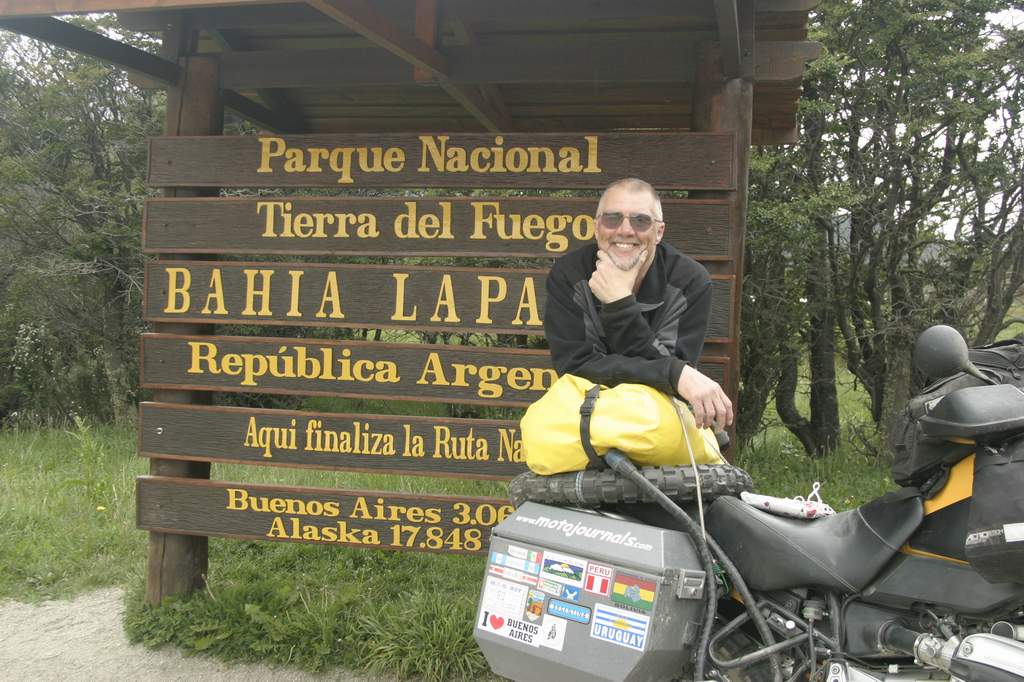 As I leave the eastern shore of Tierra del Fuego and swing southwest toward
Ushuaia, the rolling grassland yields to the foothills of the southern Andes.
It’s nice riding, although cold, and I make good time. The pavement is good, but
my suspension seems to be a bit soft. The bike wants to waddle a bit in the
frequent curves, and I silently curse my Ohlin shocks, with which I’ve never
been all that happy. At about 90 miles (150km) to Ushuaia, I enter my last
section of gravel.
As I leave the eastern shore of Tierra del Fuego and swing southwest toward
Ushuaia, the rolling grassland yields to the foothills of the southern Andes.
It’s nice riding, although cold, and I make good time. The pavement is good, but
my suspension seems to be a bit soft. The bike wants to waddle a bit in the
frequent curves, and I silently curse my Ohlin shocks, with which I’ve never
been all that happy. At about 90 miles (150km) to Ushuaia, I enter my last
section of gravel.
But it is not gravel, as much as a construction site. The road is simply
horrible, with big rocks sticking out of hard-packed earth. I mentally note some
concern and slow considerably, but I’m not much past the village of Tolhuin when
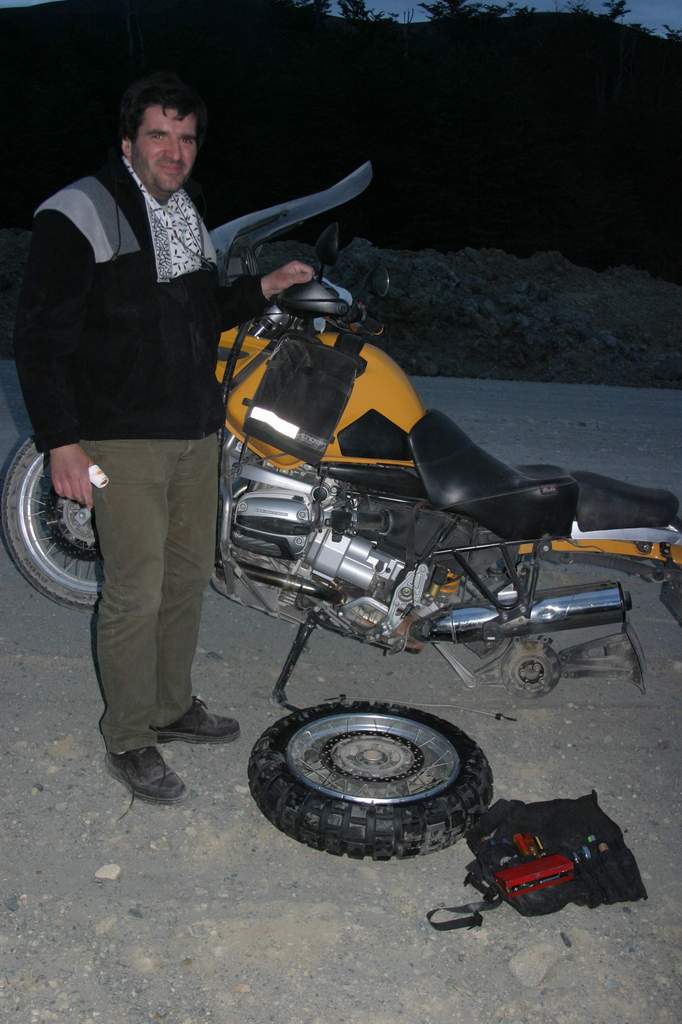
I feel the back end begin to sway, even on the rough gravel road. I pull to the
side to check things out. My back tire is flat; only the second flat on the
entire trip from Alaska to here. A quick inspection reveals that a rock has torn
out a chunk of rubber, about the size of a US silver dollar, and has exposed the
cords. The air is noisily being pushed through the cord, and the only fix
available is to replace the tire. It’s about 8pm. I need to remove the back
wheel.
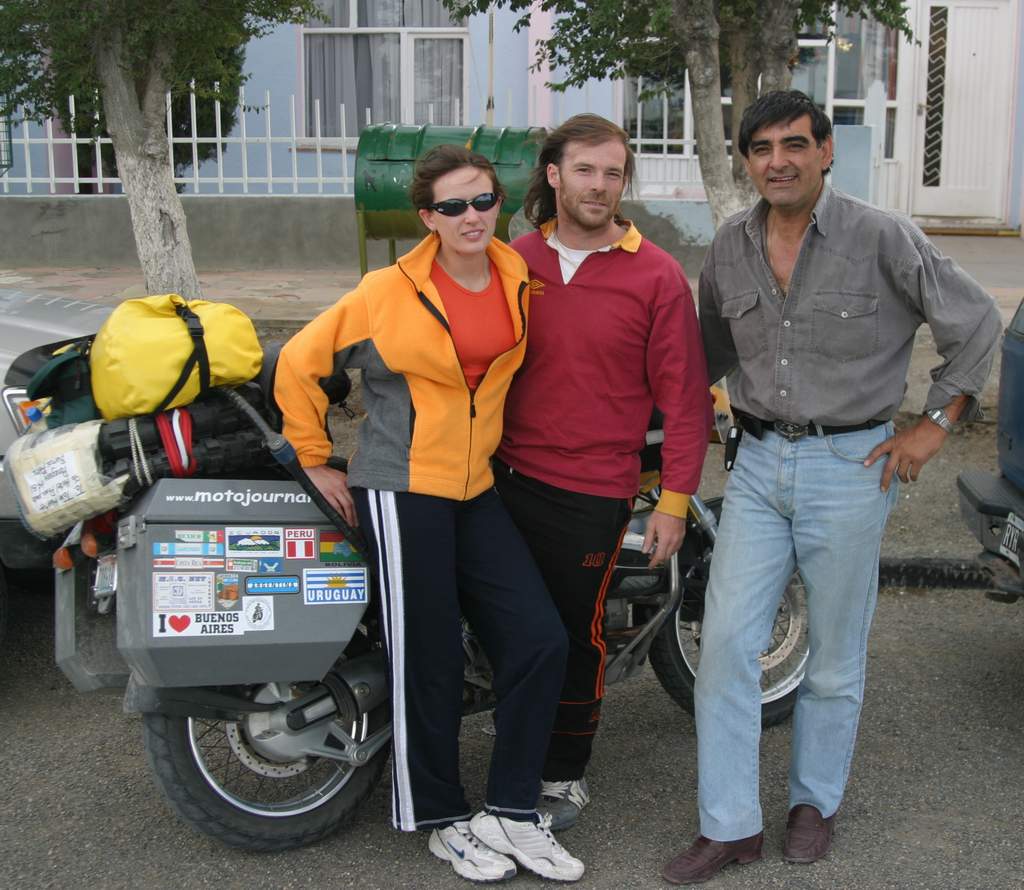
I’ve removed the luggage and hard cases by the time Claudio and Marisa, heading
from Ushuaia to Tolhuin, stop to help. Claudio and I push the bike to the
roadside, and hide my gear in the bushes. After I lock up the bike they take me
the six miles (10km) back to Tolhuim to a repair shop. My new tire is easily
installed, and I suggest to Claudio that I can get a ride back. He will have
none of it, and not only drives me back, but helps install the wheel and rear
brake, and waits until I repack my luggage. It’s after 10:30pm, and the light is
fading.
I remount the bike and head toward Ushuaia, barely able to make over 30mph on
the gravel in the darkness. For several miles the road parallels Lago Fagnano,
and the full moon reflects on the lake’s surface. Even though the road surface
is pitch dark now, the mountains stand in black silhouette against the remaining
twilight. It is an extraordinary scene.
As I slow for the police checkpoint at the eastern end of Ushuaia, I check my
dashboard clock. It reads 11:46pm. It’s Christmas Eve. While I ride to the
central district where I’ll look for a hotel the road is high on a hill, and the
city below is illuminated. A giant Christmas tree, clearly beyond the port area,
is truly conical, and perfectly lit up. Ushuaia is a fairyland tonight. Thanks
for the welcome.
(Note: I need to take responsibility for my lack of judgment. First, faced with
the same circumstances, I’d ride again in the high winds. Quite frankly, there
were few other options available. Second, while valuing the tire manager’s
opinion, the decision to not change the tires was mine alone. I should have
waited in Rio Gallegos until I found someone to do it. Finally, I should have
stopped at the first sign of the back end swaying. Unfortunately, that is
exactly the same symptom as shocks going bad. But they don’t go bad all at once,
do they? A blown back tire at high speed is a serious danger on a motorcycle. My
judgment was surely clouded by riding too long in tough conditions.)
