Huaraz, Peru
August 26, 2004
The Road to Caraz
 You
come to the City of Huaraz for the mountains, plain and simple. At 3,091 meters
(just over 10,000’) the city is high, so break out the Tylenol, and very dry, so
the vegetation is not a draw, and neither Huaraz nor the small towns nearby are
very pleasant architecturally; most having been destroyed recently by massive
earthquakes (1941, 1962 and 1970) or the resulting mud slides.
You
come to the City of Huaraz for the mountains, plain and simple. At 3,091 meters
(just over 10,000’) the city is high, so break out the Tylenol, and very dry, so
the vegetation is not a draw, and neither Huaraz nor the small towns nearby are
very pleasant architecturally; most having been destroyed recently by massive
earthquakes (1941, 1962 and 1970) or the resulting mud slides.
So, you come to Huaraz because the Cordillera Blanca has the largest
concentration of high peaks in the World, outside of Central Asia. To put this
in perspective, according to the guidebook Lonely Planet, there are fifty peaks
over 5,700m (18,600’) in this relatively small area, while there are none in all
of Europe and only three in North America (Denali in Alaska, Mt. Logan in
Canada’s Yukon Territory and Pico de Orizaba in Mexico.) At least that’s why I’m
here – I love to look at big mountains. But more about that in a minute.
I leave Loja, Ecuador Monday morning, and cross into Peru just after lunch and
on to Piura by early afternoon. The surface is generally good in Ecuador, but as
the road winds through the southern mountains, it’s tough to average more than
40mph – sometimes much less.
 But
as I cross into Peru and am headed for it’s coastal (Pacific Ocean) plain, as
the terrain levels and the road straightens and since the surface is excellent,
my speed increases dramatically. I make Piura (200 miles) by 4pm and decide to
cross the Desierto de Suchura (another 140 miles) to Chiclayo in the late
afternoon. Luckily the temperatures are moderate, the pueblos few (these are all
two-lane roads that go through the small towns, so my speed is greatly reduced,)
and Peru’s National Police are scarcer than normal, so I let the Beemer rip and
pull into Chiclayo by 6pm. I’ve done 340 miles – a long day of riding down here.
But
as I cross into Peru and am headed for it’s coastal (Pacific Ocean) plain, as
the terrain levels and the road straightens and since the surface is excellent,
my speed increases dramatically. I make Piura (200 miles) by 4pm and decide to
cross the Desierto de Suchura (another 140 miles) to Chiclayo in the late
afternoon. Luckily the temperatures are moderate, the pueblos few (these are all
two-lane roads that go through the small towns, so my speed is greatly reduced,)
and Peru’s National Police are scarcer than normal, so I let the Beemer rip and
pull into Chiclayo by 6pm. I’ve done 340 miles – a long day of riding down here.
My troubles on the way to Huaraz begin in 2003 when Ricardo marks up my map of
Peru and says “there’s a great private road here, with gates at each end. Just
ask and they’ll let you through.” Our conversation on that particular point
ended, but it was obvious from the map that it cut off as much as fifty miles on
my way to Huaraz; my next destination.
On Tuesday morning troubles on the way to Huaraz continue, while loading the
bike, I notice that my tail rack is badly cracked. The GS1150 (the BMW model I
own) tail rack essentially has two purposes: first, it provides mounting points
for the rear passenger seat, and second, it allows a way to hold the taillight
and rear fender assemblies in place; up and off the back tire if you will. In
addition the after-market manufacturers have one more use for it, a convenient
place to mount storage accessories; in my case, a Jesse top box. Now space is
extremely limited on a motorcycle, so adding a few more liters of storage space
is very attractive. Because it’s located high and far back on the bike, I
generally use it to store light weight items like clothing, although on this
trip I also have a cable lock and my computer there. However, in total I surely
have no more than ten pounds in it.
 Unfortunately, the top box mounting is poorly designed (a point that I will pass
on to Jesse Mfg when I return.) By necessity the box is at the very far end of
the tail rack to allow room for the passenger, but the real problem is that the
rack is made of cast aluminum. In short, light weight, but brittle. When
visiting us in 2002, I believe that Grant Johnson (HorizonsUnlimited; he and his
wife ten-year veterans of their own around-the-world motorcycle trip) told me
the rack was prone to cracking. Unfortunately, I didn’t act on the fix.
Unfortunately, the top box mounting is poorly designed (a point that I will pass
on to Jesse Mfg when I return.) By necessity the box is at the very far end of
the tail rack to allow room for the passenger, but the real problem is that the
rack is made of cast aluminum. In short, light weight, but brittle. When
visiting us in 2002, I believe that Grant Johnson (HorizonsUnlimited; he and his
wife ten-year veterans of their own around-the-world motorcycle trip) told me
the rack was prone to cracking. Unfortunately, I didn’t act on the fix.
Well
as I pack the bike in Chiclayo, I notice the tail rack is cracked, virtually in
half. I’ll skip all the details for now, but close to the hotel is a garage and
the owner welds two metal plates to the underside of the rack, which along with
three bolts on each side down through the rack and the metal braces, bridges the
cracks. He also welds and grinds the aluminum to hide the cracks. His repairs
might hold, I think, although I’m certain that even if they do, the tail rack
will eventually break in another spot. The constant bouncing, even on good
roads, just puts too much stress on the rack, with the top box cantilevered so
far back. But by 1pm I’m on my way to Trujillo, just 120 miles south on the Pan
Americana.
I hope to spend Tuesday night in Huaraz, which will allow me three consecutive
days in one place (a rare luxury on these trips,) so the repair has cost me a
day.
It’s Wednesday morning and I’m on the road early, and with only about 180 miles
to go, visions of arriving just after noon dance in my head, so I’ll still enjoy
the bulk of two days to view the Cordillera Blanca, which I’ve read described as
“awe-inspiring.”
Forty-two miles south of Chiclayo I find the gates to Ricardo’s cut-off, and
while I’m just a little surprised to find a gravel road, I’m not concerned. Many
motorcyclists won’t ride gravel, since it both makes the bike harder to control,
and the pounding is hard on the bike and it’s equipment, but although I’m no
dirt rider I’m technically proficient and have many, many miles on rough gravel
roads both in Alaska and the Pacific Northwest. In short – no fear.
 Two big trucks follow me through the gates, and I’m happy for the company in
case of a breakdown, but they pass when I stop to take pictures, and after ten
miles I’m alone. The road surface is quite good and standing on the pegs I make
40 – 50 mph. [For you non-riders, standing on the foot pegs accomplishes two
things: first it lowers the center of gravity of the bike, as it moves the
rider’s weight from the seat down to the pegs, making the bike much easier to
handle in loose gravel, and second, it gives the suspension a break, as the
rider’s legs absorb some of the jolts from the bumps in the road. The downside,
of course, is that it’s hard on the knees and after awhile, can get
uncomfortable.]
Two big trucks follow me through the gates, and I’m happy for the company in
case of a breakdown, but they pass when I stop to take pictures, and after ten
miles I’m alone. The road surface is quite good and standing on the pegs I make
40 – 50 mph. [For you non-riders, standing on the foot pegs accomplishes two
things: first it lowers the center of gravity of the bike, as it moves the
rider’s weight from the seat down to the pegs, making the bike much easier to
handle in loose gravel, and second, it gives the suspension a break, as the
rider’s legs absorb some of the jolts from the bumps in the road. The downside,
of course, is that it’s hard on the knees and after awhile, can get
uncomfortable.]
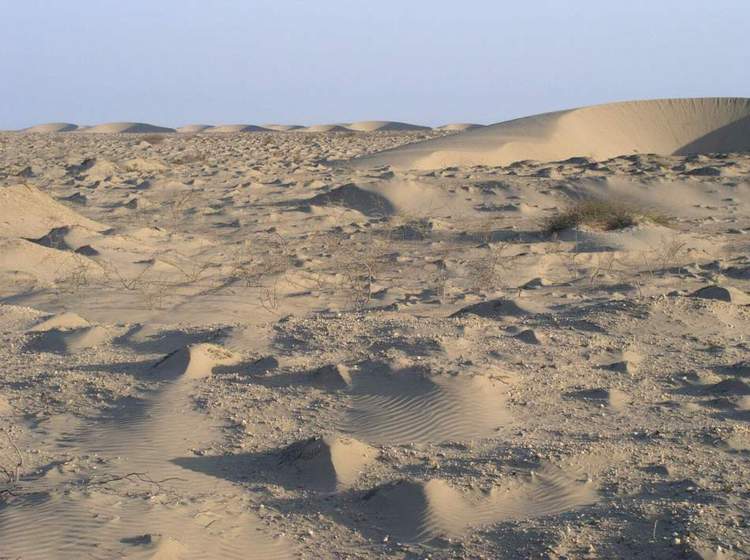
By the way, this route is essentially Death Valley. There is not so much as a
drop of moisture, a blade of vegetation, or other than the road, even a single
sign of human existence for the first fifteen miles. I’m unconcerned, though,
and other than taking some pictures, keep moving. Of course, I’ll be happy to
reach pavement again, at what I surmise will be seventy kilometers (42 miles.)
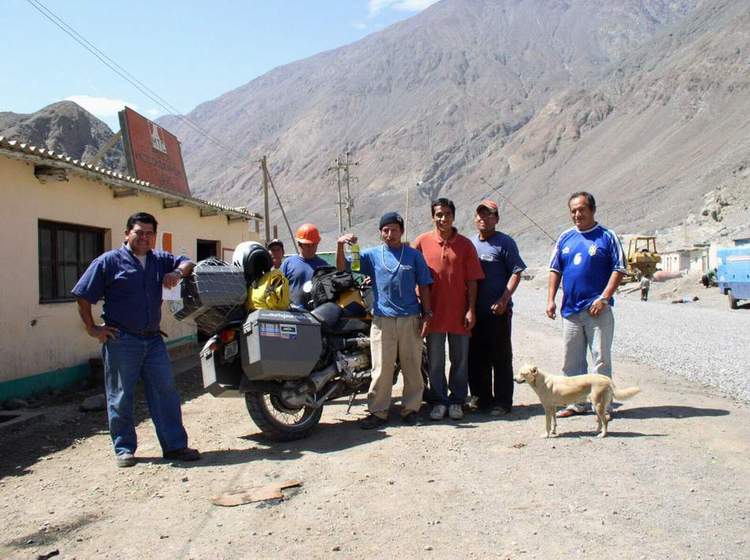
At forty-two miles I arrive at Chuquicara, a scab of a village, though really
just a construction camp from all the heavy equipment in sight, that appears to
be the staging point for a large road construction job. Perhaps that should have
been my first clue, but I stop to buy water, take some pictures and head for the
pavement. It will be a good day.
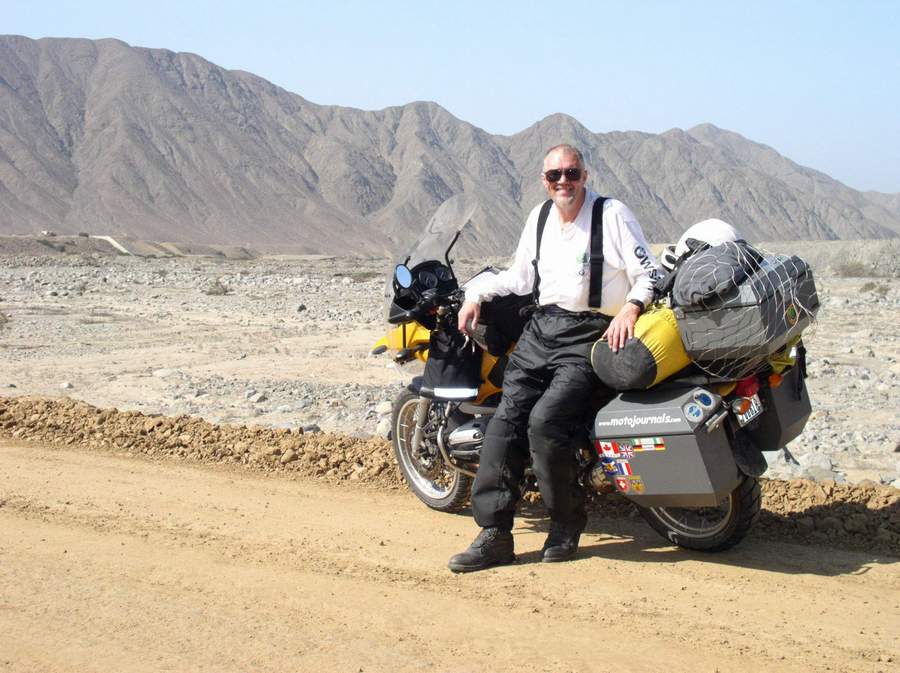 Two miles past Chuquicara the road deteriorates from bad to abysmal, and I come
to a fork without signs; a bridge to the left that looks more likely, and a road
that goes straight. There is no sensible option but to turn the bike around to
go back to camp and ask directions, and as I do so, I notice that the top box is
sitting a bit lower. Closer inspection reveals that the tail rack has failed
again. With no other choice, now, I return to Chuquicara, stop, point out the
crack to a young worker and ask if anyone in the camp can weld aluminum. The
answer is “no” but he obviously understands the gravity of the situation and
motions that I should sit tight. Without another agenda, I do as I’m told, and
quickly the young worker returns with Miharo, a slightly built, short and
compact Peruvian with a quick smile and dark, intelligent eyes.
Two miles past Chuquicara the road deteriorates from bad to abysmal, and I come
to a fork without signs; a bridge to the left that looks more likely, and a road
that goes straight. There is no sensible option but to turn the bike around to
go back to camp and ask directions, and as I do so, I notice that the top box is
sitting a bit lower. Closer inspection reveals that the tail rack has failed
again. With no other choice, now, I return to Chuquicara, stop, point out the
crack to a young worker and ask if anyone in the camp can weld aluminum. The
answer is “no” but he obviously understands the gravity of the situation and
motions that I should sit tight. Without another agenda, I do as I’m told, and
quickly the young worker returns with Miharo, a slightly built, short and
compact Peruvian with a quick smile and dark, intelligent eyes.
Together the three of us unload the rear of the bike and drop the top box so
Miharo can determine the extent of the damage. He quickly mentions that he
doesn’t have tools to weld aluminum, but might be able to fabricate a metal
brace. In the meantime, a crowd has gathered. Perhaps ten men talk to me
excitedly in Spanish about my trip, my size, the cost of the bike and helmet,
and of course, the repair. I do my best to converse, but only understand about
every twentieth word.
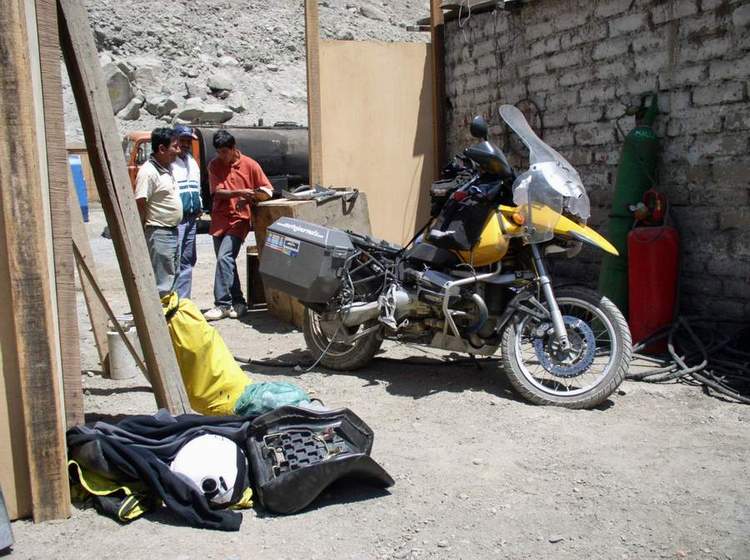
 Miharo goes to work with a welding machine and rebar. Now this is a highly
refined motorcycle, a fine example of German engineering at it’s best, and while
the thought of an unsightly piece of steel rebar attached is offensive, I’m low
on options. For two hours Miharo and his Peruvian friend work, bending and
shaping the rebar so it will support the tail rack, and thus the top box,
without interfering with its other functions that I noted earlier.
Miharo goes to work with a welding machine and rebar. Now this is a highly
refined motorcycle, a fine example of German engineering at it’s best, and while
the thought of an unsightly piece of steel rebar attached is offensive, I’m low
on options. For two hours Miharo and his Peruvian friend work, bending and
shaping the rebar so it will support the tail rack, and thus the top box,
without interfering with its other functions that I noted earlier.
In the middle of the repair, the gaggle of on-lookers who are adding little to
the process except local color, watch the rebar fashioned into its final shape,
and one offers a comment that I clearly understand and makes the assembled group
roar with laughter. “The Inca solucion,” he says. Well it turns out that Miharo
is an Indigena from Cusco, Peru, and his cosmetically crude solution has the
group in stitches, if not partly in awe from their approving nods. I concur. It
may not be pretty, but it sure looks functional. Together we re-assemble the
bike and load it.
 I’m ready to push the loaded motorcycle from the primitive shop area when I ask
the Inca the cost of the repairs, and I’m not surprised when I’m met with “cero”
and sideways shake of the head. I offer again, but he won’t take money. As I
suspected, these are just honest, hard-working men earning their daily bread and
helping a traveler in need. So, I hit upon the only other thing that I can part
with that might also be of use to him – a 3-ton capacity scissor jack that is in
my left hard bag. (Used to facilitate removal of the front tire during crating.)
While clearly very embarrassed, he accepts my token of appreciation with
dignity. The assembled men murmur their appreciation and respect, and I’m off to
Caraz.
I’m ready to push the loaded motorcycle from the primitive shop area when I ask
the Inca the cost of the repairs, and I’m not surprised when I’m met with “cero”
and sideways shake of the head. I offer again, but he won’t take money. As I
suspected, these are just honest, hard-working men earning their daily bread and
helping a traveler in need. So, I hit upon the only other thing that I can part
with that might also be of use to him – a 3-ton capacity scissor jack that is in
my left hard bag. (Used to facilitate removal of the front tire during crating.)
While clearly very embarrassed, he accepts my token of appreciation with
dignity. The assembled men murmur their appreciation and respect, and I’m off to
Caraz.
While my destination for the night is Huaraz, still over eighty miles distant,
the intermediate point is Caraz, and the point at which I’ve now been told to
expect pavement. One of the group says it’s forty kilometers (24 miles) to Caraz
and will take four hours by auto but only three hours by motorcycle. Three hours
for forty kilometers works out to eight miles per hour, and I’m a bit perplexed
by the pronouncement, but the forty-two mile gravel backtrack is equally
unappealing.
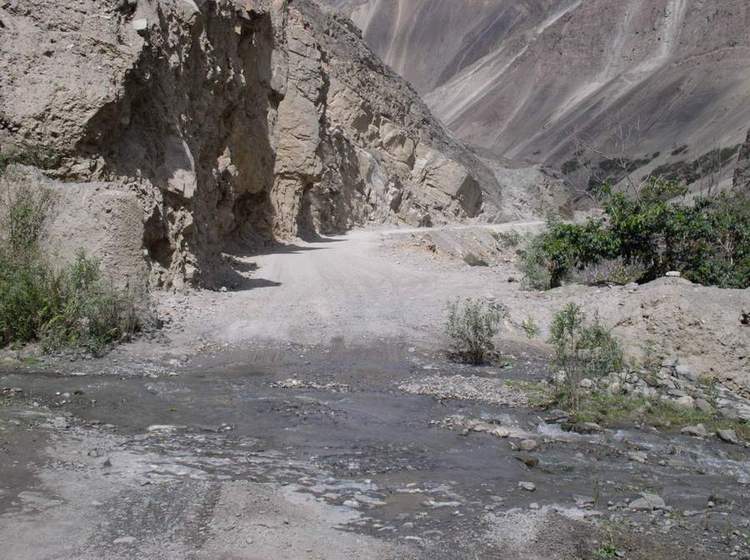 Three buses have passed through Chuquicara in the time it’s taken to affect the
repair, so at least I’ll have some company. I press on, although I realize that
I’m in serious trouble after about five miles, when it takes a half hour. I can
only describe this road as Death Valley, Dante’s Inferno and the Gates of Hell
all rolled together into one ribbon of rock I must pass to attain pavement at
Caraz.
Three buses have passed through Chuquicara in the time it’s taken to affect the
repair, so at least I’ll have some company. I press on, although I realize that
I’m in serious trouble after about five miles, when it takes a half hour. I can
only describe this road as Death Valley, Dante’s Inferno and the Gates of Hell
all rolled together into one ribbon of rock I must pass to attain pavement at
Caraz.
The gravel, angular and varying in size from peas to cantaloupes, only hides
sharp rocks below it. My concern has moved from whether the Inca Solution will
hold, to whether I can cross this particular patch of Hell without blowing a
tire, or may two. And to forestall that painful inevitability I keep the bike in
first gear and rarely hit ten miles per hour. Road moguls of eight to ten inches
high are continuous. There are no settlements or people; save two of the buses I
pass, now under repair at the roadside with varying ailments. But I’ve spent a
good deal of my adult life on motorcycles, and in some respect preparing for
this situation, and I continue forward on the road to perdition.
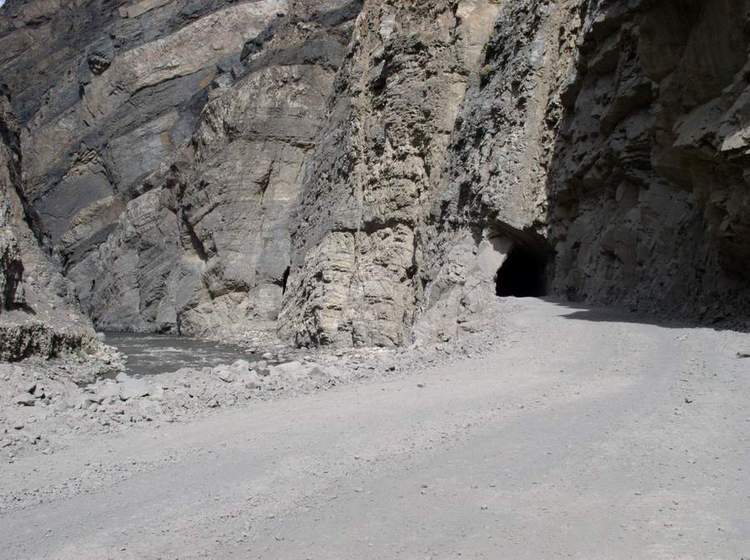 At
seventeen miles, close to one and one-half hours after leaving Chuquicara I stop
to ask a trucker who is repairing his eighteen-wheeler. “How far to Caraz,” I
ask. “Tres horas,” he replies. Three hours, I think, it was three hours from the
construction camp, well over an hour ago. But I continue on this hideous highway
– Peru Ruta 12 – carved into the narrow canyon of the Rio Santa. At many points
the canyon is so narrow that the Peruvians have resorted to tunneling through
the adjoining mountain. I lose count after twenty tunnels; each a precarious
passage in its own right. Twice I ford streams seeking the Rio Santa, and often
cross rickety bridges over its raging waters – arriving fresh and fast from the
glaciers of the nearby Cordillera Blanca. Not to overly dramatize the situation,
if that is at all possible, but this makes the Dalton Highway – to Alaska’s
North Slope – look like a walk in the park.
At
seventeen miles, close to one and one-half hours after leaving Chuquicara I stop
to ask a trucker who is repairing his eighteen-wheeler. “How far to Caraz,” I
ask. “Tres horas,” he replies. Three hours, I think, it was three hours from the
construction camp, well over an hour ago. But I continue on this hideous highway
– Peru Ruta 12 – carved into the narrow canyon of the Rio Santa. At many points
the canyon is so narrow that the Peruvians have resorted to tunneling through
the adjoining mountain. I lose count after twenty tunnels; each a precarious
passage in its own right. Twice I ford streams seeking the Rio Santa, and often
cross rickety bridges over its raging waters – arriving fresh and fast from the
glaciers of the nearby Cordillera Blanca. Not to overly dramatize the situation,
if that is at all possible, but this makes the Dalton Highway – to Alaska’s
North Slope – look like a walk in the park.
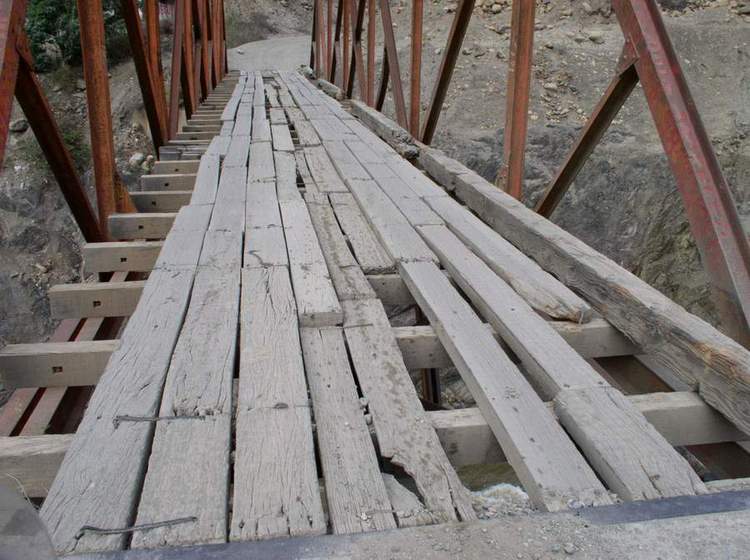 At twenty-two miles, and by my calculations close to the end of Ricardo’s
shortcut, I come across two young men leading donkeys. “Cuatro horas to Caraz,”
they affirm. Hmm. Four hours. This is not good. I quickly understand that the
time necessary to arrive at Caraz is based both on your sense of time and your
mode of transportation. Donkeys, trucks, buses and motorcycles all travel at
different speeds, so the varying answers shouldn’t be all that surprising.
Clearly, though, I’m nowhere near Caraz.
At twenty-two miles, and by my calculations close to the end of Ricardo’s
shortcut, I come across two young men leading donkeys. “Cuatro horas to Caraz,”
they affirm. Hmm. Four hours. This is not good. I quickly understand that the
time necessary to arrive at Caraz is based both on your sense of time and your
mode of transportation. Donkeys, trucks, buses and motorcycles all travel at
different speeds, so the varying answers shouldn’t be all that surprising.
Clearly, though, I’m nowhere near Caraz.
Although moving slowly, I’m up on the pegs during most of this, hoping to absorb
the jolts of the road, and both save the tires and the now fathomable scenario
of the frame breaking. Ruta 12 is also exacting a psychological toll. It’s close
to 4pm with only two hours of daylight left in this confined canyon, and not
only am I seeing a comfortable hotel in Huaraz declining with the diminishing
afternoon, but the possibly of pitching a tent is entering my mind.
My low point hits as I ride much of the next two miles through long, very dark
tunnels. These are one-way, of course, but the biggest problem is that I can’t
see the road. As I bounce from rock to rock I try to avoid the thick, high
gravel piled between the tracks, and several times nearly put the Beemer on its
side.
I don’t want to leave the impression that I’m scared to death, because I clearly
am not, but by now a hundred thoughts are going through my mind and not many of
them are good. The tension is clearly rising. Mentally I’m beginning to compute
how long my water will last. Secretly I hope that this is not the point where
I’ve finally bitten off more than I can chew.
Then up ahead I see a spot in the road, which appears to be moving in my same
direction. It might be a person leading a mule, I’ve now seen three or four, and
since I’m moving very slowly, perhaps a minute passes before I conclude that
it’s a bicycle.
Well, in another minute I catch Sjoue, a young Frenchman pedaling for four years
around the world. For a moment we simply stare at each other in amazement, then
break out in laughter at the absurdity of the situation.
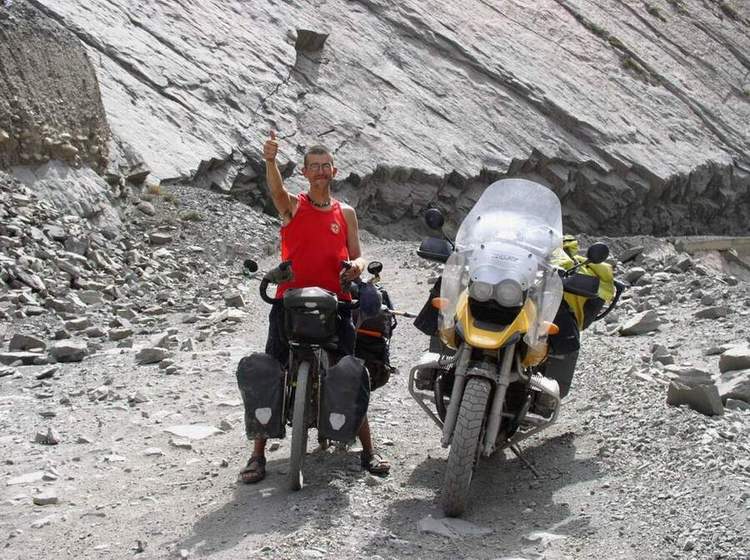 Sjoue speaks no English, I no French, and so we communicate in rudimentary
Spanish. He is very calm and is not in the least concerned either for his safety
or his arrival date in Huaraz, my anticipated destination for the night. “Caraz,”
he says, responding to my inquiries about the resumption of pavement, “maybe
tomorrow, maybe not.” I finally comprehend that he is completely at ease with
unrolling his sleeping bag on the smoothest gravel he can find once the lack of
light curtails further travel.
Sjoue speaks no English, I no French, and so we communicate in rudimentary
Spanish. He is very calm and is not in the least concerned either for his safety
or his arrival date in Huaraz, my anticipated destination for the night. “Caraz,”
he says, responding to my inquiries about the resumption of pavement, “maybe
tomorrow, maybe not.” I finally comprehend that he is completely at ease with
unrolling his sleeping bag on the smoothest gravel he can find once the lack of
light curtails further travel.
His complete lack of concern transforms me. I have some water, a river fifty
feet away and a water purifier in my panniers, a little food, tent and sleeping
bag. A few vehicles a day will pass by. This is not life threatening; merely a
bad road in the middle of a wonderful trip. We exchange e-mail addresses, toast
our respective countries with bottled water and each move on.
In the end it takes four and a half hours to travel what turns out to be almost
sixty miles from Chuquicara to Caraz, as at some point the road improves and the
last ten miles are paved. It’s another hour to reach Huaraz in the fading light.
And at the end of the day, the Inca Solution holds.
My rewards? Two, actually. First, in a very real way, I gain a much better
understanding of fear, and what it means to truly step outside my personal level
of comfort. And the second? Well as I ride the smooth asphalt on the final
thirty miles from Caraz to Huaraz I get a real treat – the sun setting on the
six thousand meter peaks of the Cordillera Blanca. Most exquisite.
