Ushuaia, Tierra del Fuego, Argentina
December 26, 2004
[Note: even though all measurements down here are in metric, and that’s the
system used by long-distance motorcycle travelers, the great majority of my
audience uses the English system of measurement, so I’m going to use that for
the rest of the trip. As needed, I’ll put the metric equivalent in parenthesis.]
Ruta 3, south from Buenos Aires
The Issues
To complete my original goal of riding from the Arctic Ocean in Alaska to
Ushuaia, Argentina, I simply need to get on Ruta 3 in Buenos Aires and head
south for approximately 2,000 miles (3,200km). The route will be well marked and
easy to find, and once I clear the suburbs, it’s the main road south to the
provinces that constitute Patagonia, and on to Tierra del Fuego. So it will be
pretty hard to get lost, at least in any substantial way.
As are almost all roads in Argentina, it will be paved, with broad shoulders and
excellent striping. Traffic should thin down dramatically as I exit Greater
Buenos Aires. The distance excepted, it should be a relatively easy ride. It is
with interest, then, that I read the note I wrote eighteen months ago when
Ricardo visited us in Seattle. On my Argentina map, between the towns of San
Antonio Oeste and Puerto Madryn, I have drawn a line from Ruta 3 to the margin,
and there I’ve written: “Ricardo says Route 3 is very tough.”
I don’t remember much else about that note, except he said that Ruta 3 was long,
straight, very boring and windy. Javier, in Buenos Aires, quotes Ricardo as
saying that “in all of Argentina there are only four curves.” An
oversimplification to be sure, but the roads in Argentina are pretty straight.
Reading a few web sites of travel in this area, and trading e-mails with at
least two riders who have completed the trip, confirms those comments. I’m a
little wary then, but not concerned.
Adding to a little twinge of anxiety is knowing that my tires will be pretty
light on tread by the time I arrive in Ushuaia. At essentially 36,000 miles
(58,000km) on the bike, just before I left Seattle in August, I installed a new
pair of Avon Distancias. I had gotten 10,000 miles (16,000km) on my last pair of
Distancias, and there appeared to be another 2 – 3,000 miles (3 – 5,000km) left
in them when I installed the new tires to start my South America trip. My
odometer read 42,000 miles (67,000km) when I arrived in Buenos Aires in
September, but at least 500 miles (800km) of the trip through Peru and Bolivia
had been on very bad gravel roads with the bike heavily loaded for at least half
that distance. So, rather than the next 5 – 6,000 miles (8 – 10,000km) that I
expected to get, I knew that I’d be lucky to get 3,000 miles. That would work
though, even adding a trip for Jan and I through Uruguay, as Ushuaia is only
2,000 miles away.
So why not just install new tires in Buenos Aires and get it over with? That
seems the logical choice. However, factor into this decision the detail that of
the 2,300 miles (3,500km) from Ushuaia to my final destination in Santiago,
Chile, at least half is gravel. I decided that I didn’t want to ride that much
gravel in street tires, like I did in Peru and Bolivia (note: street tires don’t
provide good traction in gravel and sand), so I decided that I would use a set
of off-road knobby tires. The tires I chose are model TKC-80 manufactured by
Continental. They aren’t available in Argentina, so I checked them through to
Buenos Aires as luggage.
 On my loose itinerary, I have given myself seven days to ride the 2,000 miles
south from Buenos Aires. I hope to arrive Christmas Eve, although I have no
reservations in either Ushuaia, or in towns along the way. I do need to spend a
day writing, so that leaves me six days to travel, an average of something over
300 miles (500km) per day. Two years ago I rode from Seattle to Galesburg,
Illinois for a high school reunion in just four days, and spent a morning in
Boise, Idaho having the bike serviced. The distance to Illinois is just slightly
higher. I should be fine.
On my loose itinerary, I have given myself seven days to ride the 2,000 miles
south from Buenos Aires. I hope to arrive Christmas Eve, although I have no
reservations in either Ushuaia, or in towns along the way. I do need to spend a
day writing, so that leaves me six days to travel, an average of something over
300 miles (500km) per day. Two years ago I rode from Seattle to Galesburg,
Illinois for a high school reunion in just four days, and spent a morning in
Boise, Idaho having the bike serviced. The distance to Illinois is just slightly
higher. I should be fine.
Come to think of it, riding from Buenos Aires to Ushuaia is a bit like riding
from Illinois to the West Coast of the United States, although, sadly, the Rocky
Mountains are missing. Also, it turns out that you’ll spend a great deal of time
riding through Idaho, Nevada, eastern Oregon, and other states of the Great
Basin.
The Ride
As I clear the Buenos Aries suburbs and head for my first stop in Azul, the area
is like central Illinois and Iowa; a comparison I made both while riding to
Buenos Aires and through Uruguay. Tidy farms hold well-kept houses and
outbuildings, at the end of lanes lined with trees. New cars and equipment are
ubiquitous. Corn is the main crop, although wheat is grown, and dairy herds are
in abundance. Prosperity is all around me. But as the farmland of Iowa and
Nebraska yields to the Great Plains of western Nebraska, Wyoming and Colorado,
so the corn crops and dairy herds along Ruta 3 yield to wheat farms and cattle
ranches. Trees begin to disappear. The land begins to take on, what we in the
U.S. and Canada would call “a western feel.”
December 21 is the first day of summer here, and the wheat is ripe. Amber waves
of grain (with a nod to America the Beautiful) march in unison to the stiff
breeze that appears. The harvest is in full swing and I spend a good two hours
south of Azul passing slow-moving combines and their supporting vehicles. But
their bulk and slow speed is no match for the nimbleness of my Beemer, and I
make the 250 miles (400km) to Bahia Blanca by noon.
 I had planned to continue south on Ruta 3 to Carmen de Patagones and Viedma,
where I would spend the night. However, it’s early in the day, and I can easily
make the 250 miles (400km) to San Antonio Oeste. That will give me a 500 mile
(800km) day, and I need a couple of those in case I have some days later with
poor mileage. Consulting my map it appears that the route using Rutas 22 and 251
through General Conesa is about 40 miles quicker than Ruta 3 through Viedma, and
from talking to locals, the traffic is lighter. I know how tough the last 40
miles of a long day can be, so it’s an easy decision. I point the bike west, up
shift through all six gears to the allowable maximum speed limit of 68 mph
(110kph), and head for Rio Colorado, my intermediate stop.
I had planned to continue south on Ruta 3 to Carmen de Patagones and Viedma,
where I would spend the night. However, it’s early in the day, and I can easily
make the 250 miles (400km) to San Antonio Oeste. That will give me a 500 mile
(800km) day, and I need a couple of those in case I have some days later with
poor mileage. Consulting my map it appears that the route using Rutas 22 and 251
through General Conesa is about 40 miles quicker than Ruta 3 through Viedma, and
from talking to locals, the traffic is lighter. I know how tough the last 40
miles of a long day can be, so it’s an easy decision. I point the bike west, up
shift through all six gears to the allowable maximum speed limit of 68 mph
(110kph), and head for Rio Colorado, my intermediate stop.
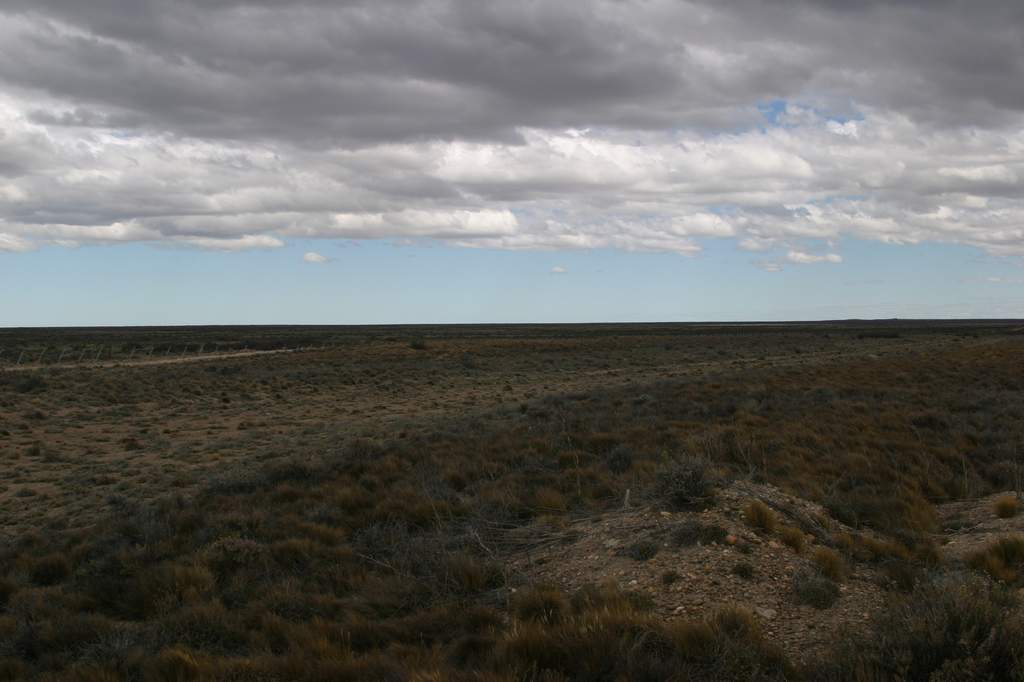
Whoa! What happened to the wheat fields? How did we get through eastern Colorado
so quickly? Why are we suddenly in Nevada? I can’t answer that, but we are.
Leave the southern industrial developments of Bahia Blanca behind and the
terrain turns to the flattest scrubland that I have ever seen. There is not a
rise to be seen. Not a green blade of grass. Apparently not a drop of water
either. Just mile upon mile of small bushes that don’t appear to support a
living thing. Infrequently a small house appears with some dilapidated out
buildings and rusted machinery. Most are deserted. Prosperity seemingly found
another venue.
On the plus side the road has a great surface and is as straight as an arrow. It
allows high speeds, but it is very boring. The wind picks up considerably.
I stop for gas and a snack in the pueblo of General Conesa and as usual, folks
drift over to admire the bike and ask questions. I’ve barely started on my snack
when a young American lady stops by to talk. She is a PhD candidate in
archeology at Texas A&M University and is doing field work nearby, for her
dissertation. She has two local helpers nearby. She mentions that she looks
forward to joining her husband in Texas in May, but has enjoyed Argentina. I
believe that she enjoys her fifteen minutes with a fellow American. Her helpers
in tow, she hops into her beat up Ford pickup and leaves to have a flat tire
repaired.
 A couple, he a motorcyclist and she an engineer in a fish processing plant in
San Antonio Oeste, engage me for some time. In excellent English she peppers me
with questions. Where are you from? Where are you going? Do you like Argentina?
How long have you been on the road? I have to excuse myself after twenty
minutes, but not before they confirm that the beach town of Las Gratis (just
fifteen miles down the road from San Antonia Oeste), my actual destination for
the night, is a great choice. Chris and Erin Ratay (www.ultimatejourney.com)
stayed there and wrote: “a nice little town with a great beach and inexpensive.”
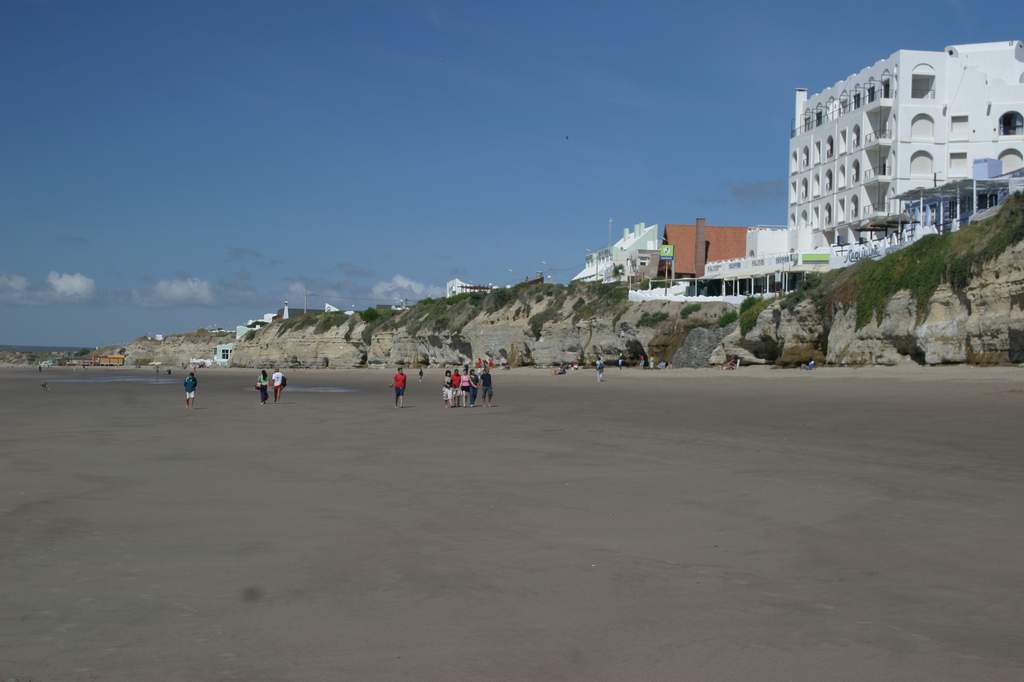
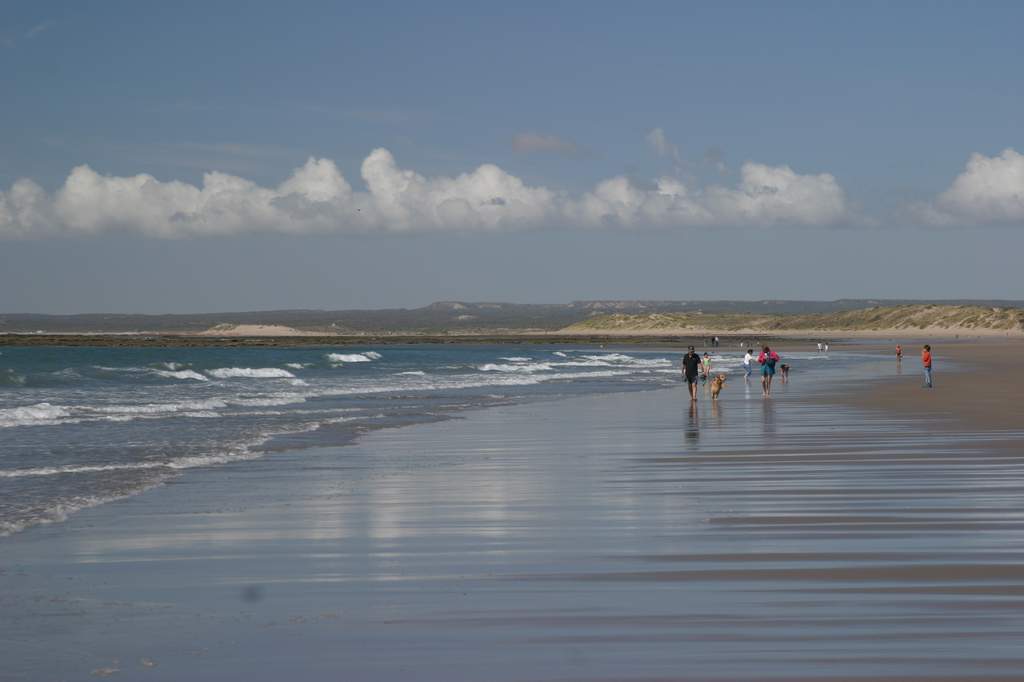
It sounds like my kind of place. I decide to stay two nights and spend one day
writing. As fate would have it, I find a nice room with a view of the South
Atlantic Ocean.
A couple, he a motorcyclist and she an engineer in a fish processing plant in
San Antonio Oeste, engage me for some time. In excellent English she peppers me
with questions. Where are you from? Where are you going? Do you like Argentina?
How long have you been on the road? I have to excuse myself after twenty
minutes, but not before they confirm that the beach town of Las Gratis (just
fifteen miles down the road from San Antonia Oeste), my actual destination for
the night, is a great choice. Chris and Erin Ratay (www.ultimatejourney.com)
stayed there and wrote: “a nice little town with a great beach and inexpensive.”
It sounds like my kind of place. I decide to stay two nights and spend one day
writing. As fate would have it, I find a nice room with a view of the South
Atlantic Ocean.
The Southern Cross proves elusive as I search the night sky, but the ride is
going just fine. And I think the tires will hold to at least Rio Gallegos.
